
Medical College of Wisconsin Pediatric Residency Curriculum
The curriculum of our training program intends to provide a broad base of instruction and experiences, supplemented by elective experiences, that will allow each resident to acquire the breadth and depth of knowledge and skills required to be an outstanding pediatrician, and also permit each resident to pursue their individual career goals.
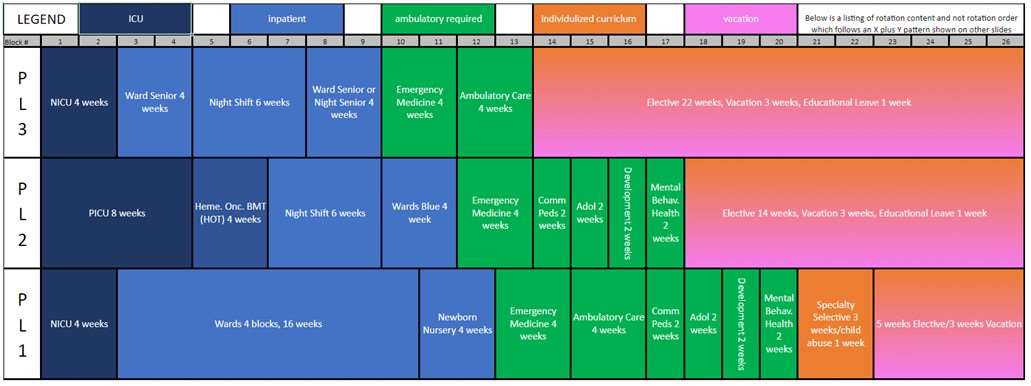
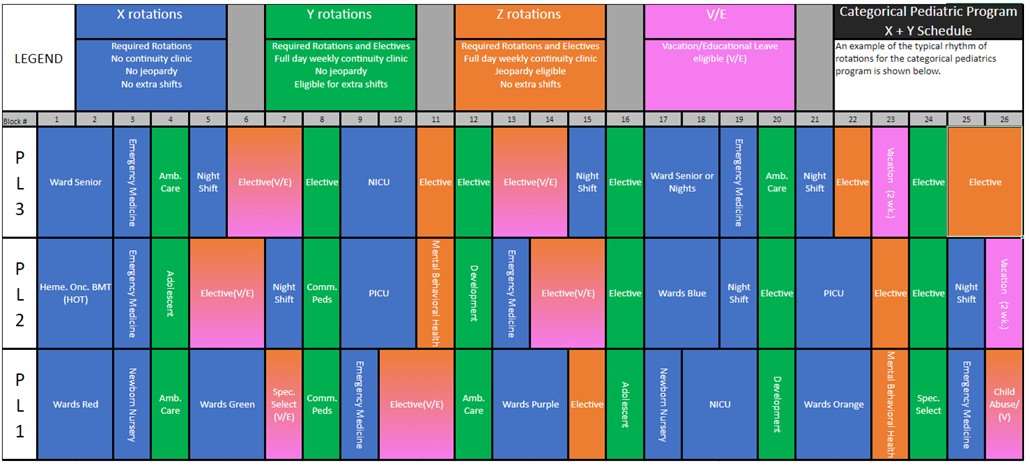
At the beginning of training, residents are very closely supported and supervised, with the opportunity to gradually increase in autonomy and responsibility as the resident gains increasing comfort in the in-patient and ambulatory settings. By the PL3 year, residents have been prepared to appropriately care for all patients in the hospital and in the clinics, and to assume a primarily supervisory and teaching role for their more junior colleagues.
By the completion of residency training, our residents are very well-prepared to practice independently as primary care pediatricians, as pediatric hospitalists, or to continue further training in the fellowship training program of their choice.
We have incorporated an X+Y+Z schedule for our program. Residents have 3 weeks of vacation each year. PL2s and PL3s also get one week of educational leave.
Curriculum Information
-
PL1 Year
The PL1 pediatrics residency year includes a variety of in-patient and ambulatory experiences that promote the development of independent patient care skills, medical knowledge, enhance communication skills and professionalism.
PL1 Year -
PL2 Year
The PL2 year in our pediatric residency is a transitional year between the broad experiences in year one and the more autonomous in year three. Residents gain additional experience in pediatric critical care, and have more ambulatory experiences.
PL2 Year -
PL3 Year
The PL3 year our pediatrics residency is designed to further refine patient care skills, expand medical knowledge, develop supervisory and teaching skills, and to utilize elective time to explore individual interests.
PL3 Year -
Electives
Our elective experiences allow residents to explore their specific interests in pediatric medicine while working with many world and national experts in their respective pediatric subspecialties.
Electives -
Continuity Clinic
Our residents have over 20 full days of continuity clinic each year where they learn the basics of primary care and community pediatrics. Residents can attend one of two urban clinics, the Midtown Pediatrics-Children's Wisconsin, and the 16th Street Clinic, or one of several pediatric practices in Milwaukee and its suburbs.
Continuity Clinic -
Conferences and Workshops
On Senior Rounds our residents discuss their patients, supervisory clinical experiences and cutting edge pediatric medicine. Multiple faculty also join the group on a weekly or bi-weekly basis to provided expertise in their fields.
Conferences -
SURFboards Pediatric Boards Preparation Program
The SURFboards Pediatric Boards Preparation Program is a comprehensive boards review program that spans throughout the entire residency starting during orientation.
SURFboards -
Residents as Educators
The Residents as Educators curriculum is a dynamic, interactive and relevant one that walks residents through basic educational terminology and builds up to the challenge of helping learners.
Residents as Educators -
Wellness and Mindfulness for Residents
Wellness and Mindfulness for Residents focuses on exploring and experiencing methods, strategies, and mindsets that enhance both personal and professional wholeness.
Wellness -
Resident Feedback and Input
Resident input regarding all aspects of the residency program is continually and actively solicited and valued.
Feedback -
Quality Improvement Training
Learn about our innovative program to train pediatric residents in quality improvement through the work of Dr. Paula Soung, QI Curriculum Director, QI faculty advisors and the pediatric chief Residents.
QI Training -
Global and Community Health Experience
The Medical College of Wisconsin Department of Pediatrics Global and Community Health Program is an integral part of the pediatric and med-peds residency training programs.
Global and Community Health