header-logo
Medical College of Wisconsin Medical School Medical School

MCWfusion Curriculum Phase 3: Individualization
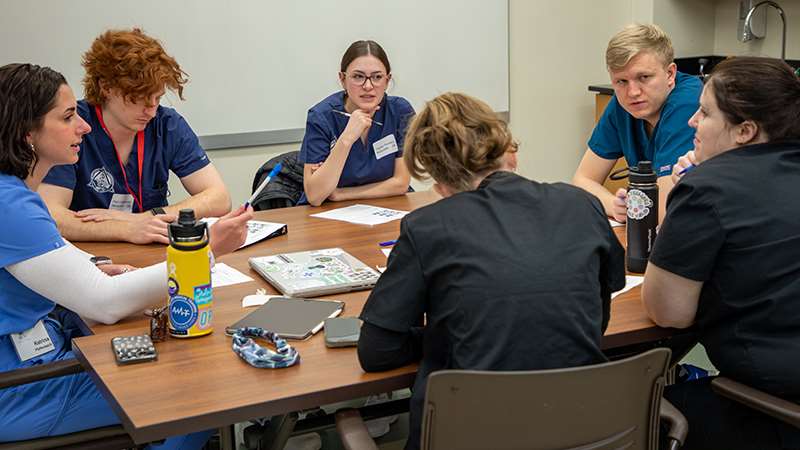
Medical students discussion in classroom

Phase 3 Overview

During Phase 3 of the MCWfusion Curriculum, students will individualize their training, differentiating towards their specialty choice.

Phase 3 duration:

  • MCW-Milwaukee campus: 17 months
  • Regional campuses (MCW-Central Wisconsin and MCW-Green Bay): 10 months

Course requirements include:

  • Two (2) Acting Internships (core plus core/noncore)
  • One (1) Integrated Science Selective course (at least 50% Foundational Science focus; virtual/in-person/hybrid opportunities)
  • Preparing for Residency course
  • Completion of Scholarly Concentrations
  • Elective courses will fulfill remaining credits for completion of Phase 3

Phase 3 Course Descriptions

all
Preparing for Residency

The Preparing for Residency course is aimed to prepare students to be successful in residency. Students will work on developing a competitive residency application, practice interviewing skills, and will be assessed on the 13 entrustable activities (EPAs) recommended by AAMC for residency. Students will partner with their learning community navigators and others to address gaps and to build medical discipline specific skills. As part of this course, students will select a specialty-specific track.

Acting Internships

Acting Internships allow students to experience the responsibilities of an early year intern, including the requirement for initial patient assessments as the "physician of first contact.” Students are provided with appropriate supervision by faculty physicians, residents, and other healthcare professionals for all patient care activities. Students will experience an intern level of responsibility and autonomy and participate in overnight call (or night float) as appropriate for a particular service. These internships are hospital-based and include Core Acting Internships (in the core clerkships: Internal Medicine, Pediatrics, Surgery, Obstetrics/Gynecology, Family Medicine, Psychiatry) and Non-core Acting Internships (rotations outside of core areas or highly specialized patient care services). Students must successfully complete two (2) Acting Internships during Phase 3.

Integrated Science Selectives

Integrated Science Selective courses aim at reinforcing, integrating, and enhancing student mastery of foundational science content, especially as it applies to disease mechanisms, diagnosis and clinical decision making, enhancing science literacy as demonstrated by incorporation of evidence-based medicine into practice, and preparing students to incorporate and discuss foundational sciences in their pursuit of a field of interest. All Integrated Science Selective courses focus on basic science or foundational sciences as they apply to clinical care and are directed by a foundational scientist and a clinician. These courses utilize journal clubs and often integrate direct patient care, case discussions, and/or clinical conferences. They are delivered in 4-week traditional, virtual, and asynchronous models. Students must successfully complete one (1) Integrated Science Selective during Phase 3.

Phase 3 Calendar (MCW-Milwaukee and Regional Campuses)

Due to the nature of individualization of Phase 3, the image below represents a potential schedule of one student. In addition, students on the MCW-Milwaukee campus can use two of the elective blocks in Phase 3 as vacation time.
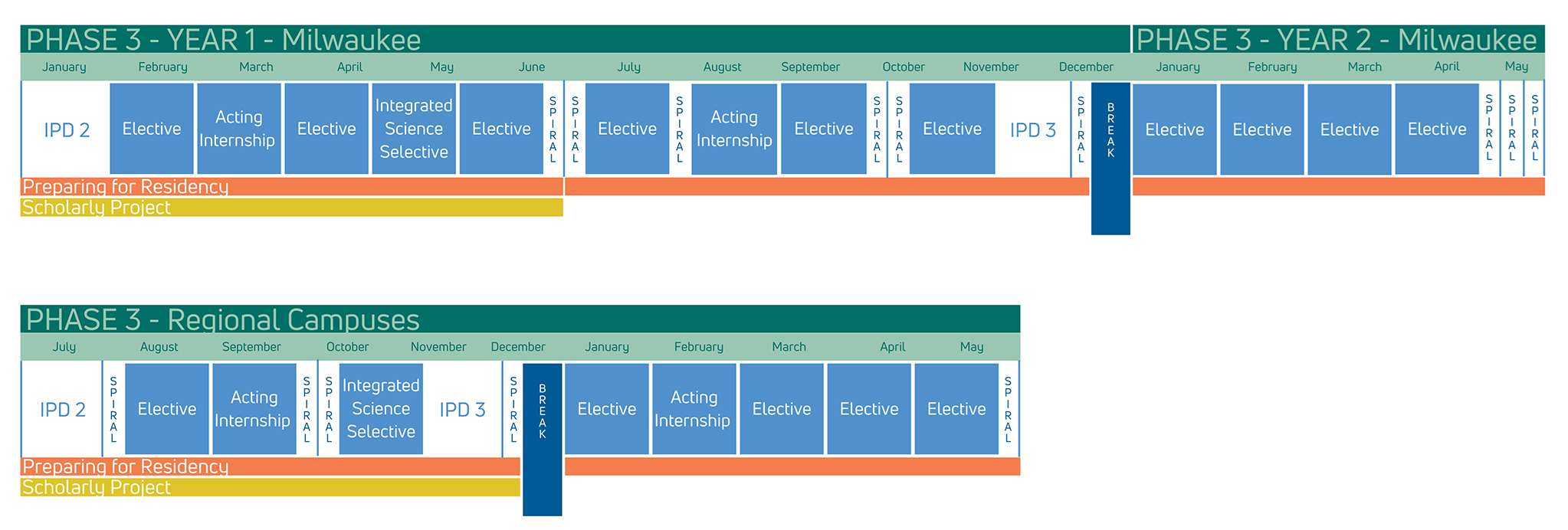
MCWfusion Curriculum | Calendar Map Phase 3

Phase 3 Tracks

Primary Care and Medical Specialties

Acute Care/Emergency Medicine

Surgical Procedural

Mind, Brain & Body

Diagnostics & Therapeutics

Undifferentiated

Accelerated Regional Campus (ARC)

  • Tracks are guided paths of menus of required and elective experiences for students. They include the following:
    • Specialty-oriented Acting Internships
    • Integrated Science Selectives
    • Clinical & Research Electives
    • Specialty-specific preparation for residency
  • Tracks allow for specialty-oriented individualized curriculum that also ensures adequate general physician training.
  • Tracks support individualization of medical training and organize student experiences.
  • Tracks may have required courses, recommended courses, and/or suggested courses.
  • Tracks may give preference for certain high demand low-capacity courses to students within a Track.
  • Tracks offer extracurricular activities.
  • Students retain the ability to take courses outside of what’s defined in their Track.