
MCW Researcher Finds Cosmic Radiation Damages the Heart Long After Exposure
From the moment they blast off into space, astronauts face physiological changes unlike any they faced on Earth.
The effects of weightlessness can be immediate – from motion sickness to swelling and pressure inside their bodies – but the long-term consequences of space travel aren’t immediately apparent.
At the Medical College of Wisconsin (MCW), a research team set out to uncover what influence both galactic cosmic radiation and zero gravity may have on the heart and immune system.
They found that the cosmic radiation astronauts would be exposed to on a trip to Mars has the potential to damage the heart – but the damage is only visible many months after radiation exposure.
The research team also uncovered other possible health risks – including a disrupted immune system and damaged DNA – that astronauts must contend with long after they return home. Understanding these risks is especially pertinent now, as NASA plans for long-duration space travel to Mars and beyond.
“As humanity prepares for extended missions to the Moon and Mars, we need to understand not only what happens to astronauts during a mission, but what happens to their biology months and years afterward," says John Baker, PhD, lead researcher on the study and a professor of surgery at MCW. "This study gives us a clearer picture of that long-term risk and identifies important questions we need to answer before sending people on these missions."
The study, published in PLoS One, was conducted in collaboration with investigators at Lawrence Berkeley National Laboratory and Wake Forest School of Medicine.
Heart Damage Appears Long After Radiation
The potential health hazards of galactic cosmic radiation and microgravity have long been documented. Without Earth’s atmosphere to protect them, astronauts are bombarded with radiation, increasing their risk of developing cancer and heart disease. Long durations of weightlessness have been shown to cause muscle atrophy and bone deterioration.
But Dr. Baker and the team set out to determine how radiation and microgravity combined damages bodies. To find out, they traveled to NASA's Space Radiation Laboratory at Brookhaven National Laboratory.
For the experiment, they exposed rat models to 0.75 gray of radiation. A gray is the international unit to measure the absorbed dose of ionizing radiation, and 0.75 gray is the dose that astronauts would likely be exposed to on a trip to Mars. Some of those rat models also underwent simulated weightlessness. Other groups received only the radiation or only underwent weightlessness.
 The team then studied the rat models for 360 days. After that time period, the rat models exposed to radiation had developed twice as much stiff scar tissue around the blood vessels in their hearts – a condition called cardiac fibrosis, which is an early indication of heart disease – as the unexposed control group had.
"What surprised us most was how strongly time influenced what we saw,” Dr. Baker says. “A radiation exposure that appears less damaging when viewed over a shorter period can reveal significant cardiac injury when the animals are followed for a much longer time. We need to think about radiation risk not simply as a dose, but as a biological process that can continue unfolding long after the exposure occurs.”
Interestingly, the researchers found that combining radiation and simulated weightlessness did not always make the health effects worse. The rat models that underwent both had similar levels of cardiac fibrosis as those that received radiation alone.
“This suggests that different spaceflight stressors can affect different biological systems independently rather than simply adding them together to produce greater damage,” Dr. Baker says.
Weightlessness Disrupts Immune System
The team tested those other biological systems, as well. The rat models that underwent simulated weightlessness had reduced levels of cytokines, proteins within the body that help regulate inflammation and the immune system.
In fact, the study identified six cytokines that were altered in both the rat model and the landmark NASA Twins Study, supporting the potential value of the rat model for understanding human responses to weightlessness.
The researchers also performed whole-genome sequencing on blood cells from a small subset of animals exposed to a higher radiation dose – 1.5 gray instead of 0.75 gray. They found radiation-associated genetic variants in genes linked to biological processes relevant to human disease.
“What we saw was evidence for abnormal repair of DNA,” Dr. Baker says. “The older you get, the more chance there is that your DNA has mutated and not been repaired. I think what we may be seeing here is that radiation is accelerating this aging.”
Implications for Life on Earth
The findings could help inform future studies of astronaut health and the development of strategies to protect astronauts from the combined stresses of radiation and reduced gravity.
They may also have relevance beyond spaceflight, because radiation-induced scarring within the heart, immune dysfunction, and genomic changes could potentially result from radiation exposure on Earth, as well. Airline crews, for example, are exposed to more radiation than the average public, as are people who work in the nuclear energy industry.
“Protons, which make up 90 percent of galactic cosmic radiation, are also being used to treat cancers in the chest,” Dr. Baker says. “Understanding their impact on the heart is critical for long-term cancer survivorship.”
Dr. Baker is currently studying the impact of radiation and weightlessness on bacteria present in the roots of plants. If humans were to embark on long-distance space travel, they would likely need to grow plants to eat.
“If radiation disrupts the microbial population that the roots rely on, the plants won’t grow correctly,” Dr. Baker says. “If that happens, it would be a showstopper for having fresh food on the flight.”
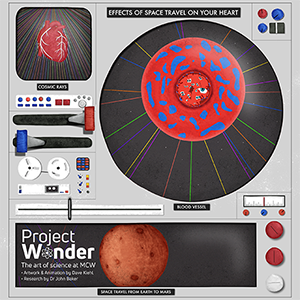
Project Wonder: Space Travel and Heart Health
Project Wonder: The Art of Science pairs Medical College of Wisconsin (MCW) researchers with local artists and writers to interpret their research through one-of-a-kind artistic representations.
In Space Travel and Heart Health, artist Dave Kiehl animates the innovative research of John Baker, PhD, professor of surgery at MCW.
Recommended


