
Hot on the Trail of Cold Tumors
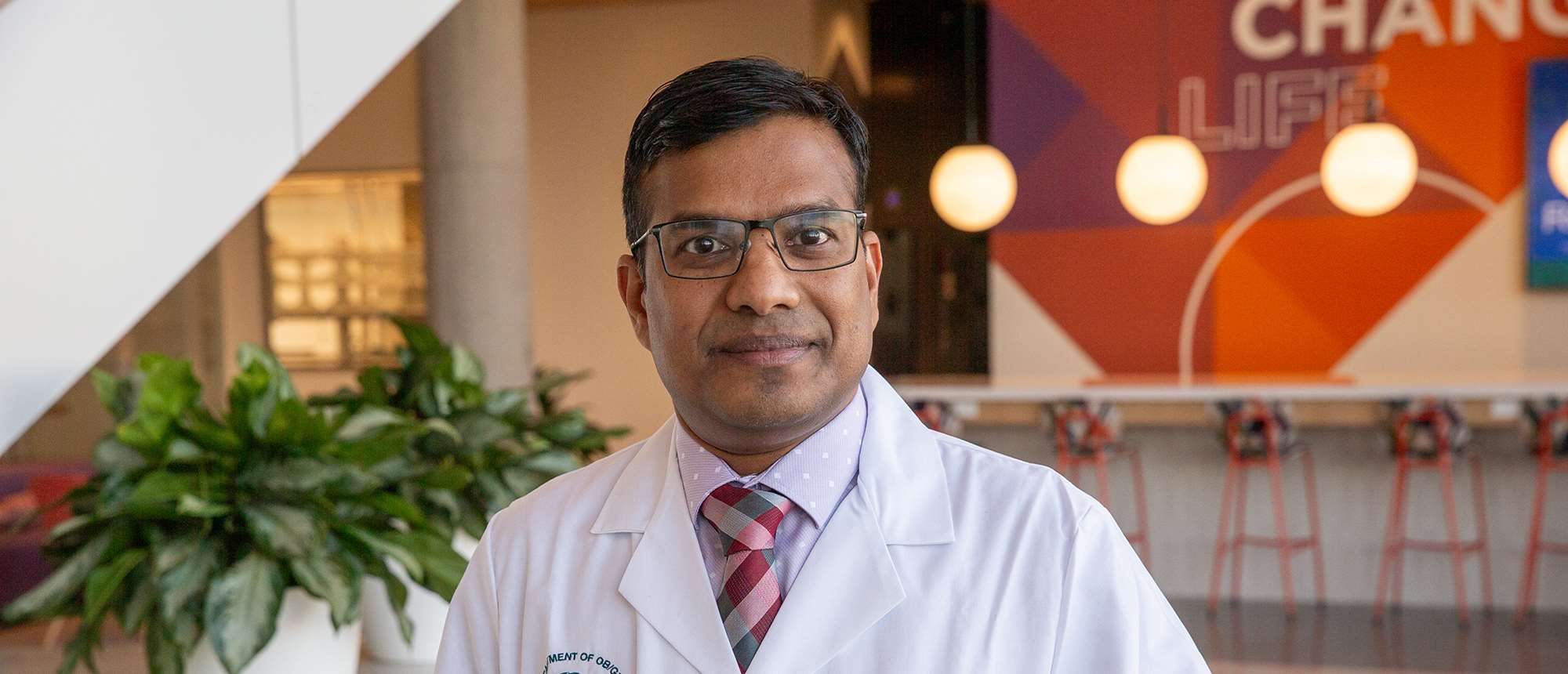
Pradeep Chaluvally-Raghavan, PhD, an associate professor in obstetrics and gynecology, grew up in a quiet village in Kerala, southern India, where he loved participating in his high school science fairs. His projects ranged from explaining how rockets launch space shuttles, to studying how electrification impacts muscle movement using dead frogs.
Dr. Chaluvally-Raghavan, also the Linda G. and Herbert J. Buchsbaum, MD Chair in Gynecologic Oncology, began college planning to become a doctor but soon realized he was more interested in understanding how diseases disrupt the body’s normal functions, especially at the molecular and cellular level.
“I was always asking a lot of questions in my science classes and sometimes so many that I probably annoyed the teachers and classmates,” he says with a laugh. “I was always asking, ‘Why? Why?’”
Having grown up speaking Malayalam, Dr. Chaluvally-Raghavan had to learn English in graduate school so he could apply for grants, write journal articles, and attend conferences. As he worked to master the language, his mentors supported him and sparked his interest in cancer immunology. For his dissertation, he studied how the protein NF-κB and inflammatory molecules in the immune system helped melanoma spread in mice.
After graduate school, he moved to Israel to do a postdoc at the Weizmann Institute of Science. There he developed 3D cell culture models to study a type of breast cancer called ductal carcinoma in situ (DCIS) and discovered how several genes work together to transition DCIS from non-invasive to invasive cancer.
He also got to try out some brand-new technology for the time – microarrays, a tool that allows scientists to measure the activity of thousands of genes at the same time and see which are turned on and which are turned off.
“It was overwhelming at first,” Dr. Chaluvally-Raghavan says of making the leap to a place that had such state-of-the-art equipment. “But it gave me a spark to do fascinating science using discovery approaches.”
Following a Gene’s Protein Signal
After his postdoc, Dr. Chaluvally-Raghavan took a fellowship at MD Anderson Cancer Center in Houston, and, with funding from the Ovarian Cancer Research Alliance and Marsha Rivkin Center for Ovarian Cancer Research, expanded his work to include ovarian cancer.
There, he used a technique called reverse phase protein array, which enabled him to analyze proteins and their post-translational modifications – the chemical changes that occur after a protein is produced and that regulate how it functions. When these regulatory changes are disrupted, they can contribute to cancer development.
Finally, in 2016, he came to MCW, where his lab made several discoveries that could transform how we treat ovarian and other cancers.
For instance, his research identified that tumor cells package messenger RNA (mRNA) from a gene called FXR1 into tiny extracellular vesicles that enter the body's immune cells and reprogram them to become immunosuppressive, allowing cancers to grow unchecked.
"Ovarian cancer is usually a 'cold' tumor," he says, "meaning it doesn't respond well to immunotherapy. By understanding how this process works, we hope to develop new treatments that can be combined with immunotherapy to make it more effective."
Modified Treatment for Targeted Cancer Therapy
Dr. Chaluvally-Raghavan's research has led to several patented technologies. One is a method to silence FXR1 mRNA in cancer cells, which is now being tested in preclinical animal studies.
While the primary focus has been ovarian cancer, FXR1 is expressed in multiple other cancers including lung, head and neck, and cervical cancers, suggesting the therapy could be translated across different tumor types. A manuscript with initial results is currently under review.
With a new $2.5 million R01 grant from the National Institutes of Health, he's investigating how FXR1 gets packaged into these tiny particles and how they affect the tumor's surroundings and influence a tumor suppressive microenvironment.
He says a better understanding of FXR1 expression could help physicians use it as a biomarker to diagnose certain cancers earlier or predict which patients will respond to immunotherapy.
His lab has also developed an antibody that blocks OSMR, a protein that sits on the surface of some aggressive cancer cells and helps tumors resist chemotherapy. OSMR appears in ovarian cancer, glioblastoma, and pancreatic cancer, suggesting the therapy could help patients with multiple cancer types.
"I'm very optimistic," he says. "I believe the discoveries we have made will make a difference in patients' lives sooner than later – and I hope it will be very soon."
Recommended


