
Pinpointing Pain to Develop New Therapies
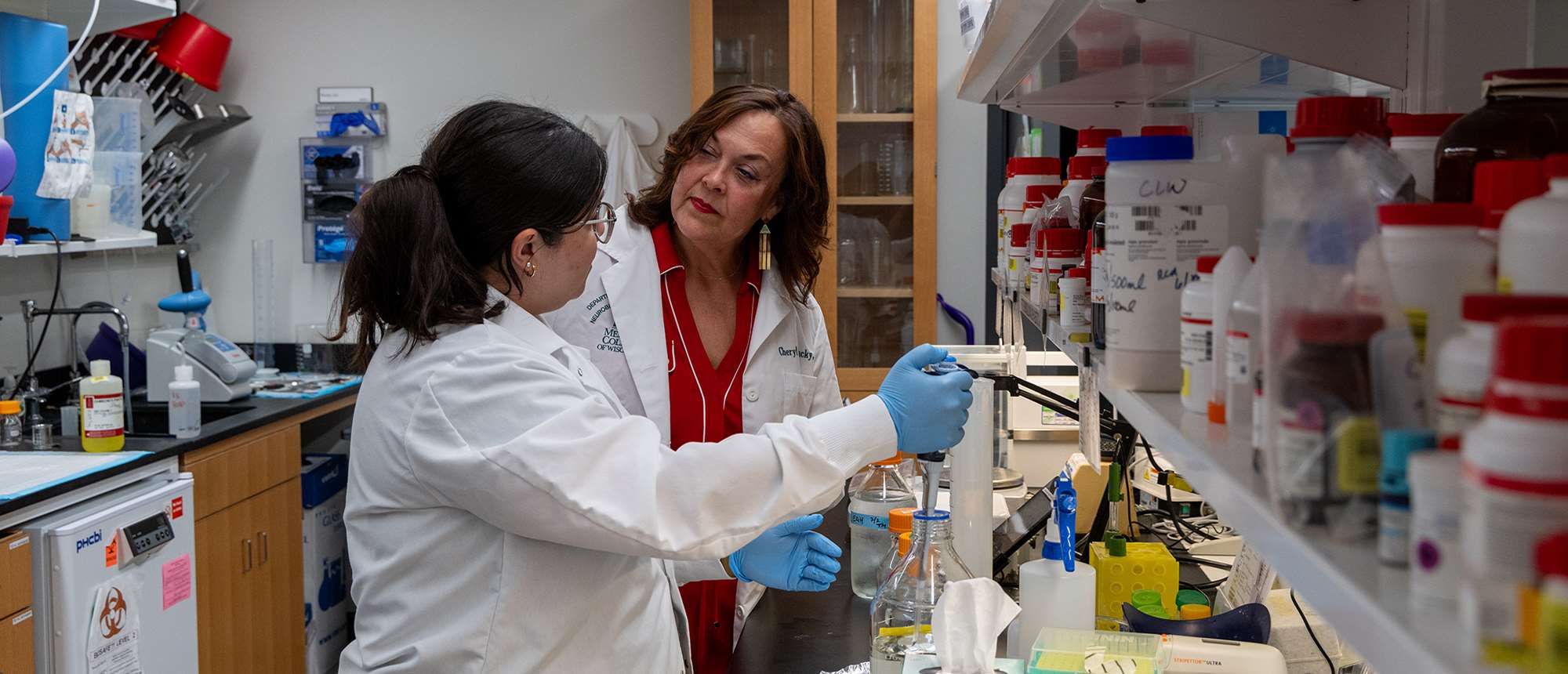
Whether from touching a hot stove or accidentally slicing a finger on a sheet of paper, the unpleasant pain signal that zings through our bodies is an important tool that helps us survive.
But when pain has no such benefit or becomes chronic, it can lead to depression, expensive medical bills, and addiction to pain-relieving medications.
At the Medical College of Wisconsin (MCW), Cheryl Stucky, PhD, is looking for a new way to treat pain. As the Marvin Wagner Professor of Cell Biology, Neurobiology, and Anatomy, she studies pain signaling in human tissues at the smallest levels, hoping to unlock the mechanisms within neurons that transmit pain to the central nervous system.
By studying pain in conditions like sickle cell disease and by understanding how nerves interact with skin cells, Dr. Stucky hopes to develop a new therapeutic that could stop unnecessary pain in its tracks.
“Once you understand exactly what’s going on with the underlying proteins, you know what to target in humans with pain,” she says. “That will allow us to alleviate chronic pain, and that’s what we’re really excited about.”
Recording Ion Channels Within Neurons
Dr. Stucky has been studying the neuroscience of touch and pain for more than two decades. She’s motivated by the fact that 1 in 4 people suffer from chronic pain, which experts estimate costs more than $600 billion in the United States each year, including healthcare costs and lower worker productivity.
When Dr. Stucky arrived at MCW in the 1990s, she led one of the first labs in the United States to record the electrical activity of peripheral nerves in animal models.
Today, she is extending that research to humans. Using tissue from deceased donors, Dr. Stucky and her team are introducing pain stimuli to cells in the peripheral nervous system that send nerve fibers to our fingers, for example, to better understand which ion channels, or small pores in the cell membrane, allow them to respond to that stimulus.
The team uses single-channel recording, which allows them to record the electrical activity of one ion channel at a time. They had clues from animal models as to which channels might underlie painful touch, but this had not been shown for humans.
“If we found the channels that cause mechanical pain in humans, it would be a big game changer for sensory science and pain research,” Dr. Stucky says.
Skin Cells Work in Concert with Neurons
The lab is interested in specific treatments and conditions that cause pain, including chemotherapy and sickle cell disease. Chemotherapy treatments degenerate nerve fibers, causing numbness and sores. People with sickle cell disease face devastating pain from red blood cells clogging vessels and hypersensitivity to cold and heat.
People with sickle cell disease often end up in the emergency room because they are in so much horrific pain, but the cause of their pain is not immediately clear to nurses and physicians, which can lead to misdiagnoses.
“They are often treated like drug seekers looking for opioids,” Dr. Stucky says. “If we understand the underlying mechanisms that cause this pain in these patients with sickle cell disease, we can treat it better.”
While studying conditions like these, the Stucky lab has also figured out just how pain signals are sent from the source of pain. Cuts or burns, for example, don’t simply cause the peripheral nervous system to send a pain signal to the brain. That signal actually involves the top layer of skin cells called keratinocytes.
In the past, this skin layer was thought of as simply a protective barrier. But Dr. Stucky’s lab discovered that the keratinocytes themselves respond to pain stimuli and then convey that information to neurons.
A Targeted Therapy for Chronic Pain
The goal is to take all this information – the mechanisms of ion channels, the behavior of skin cells – to create a targeted therapy for chronic pain. That could mean a pharmaceutical drug or even a lotion.
“We want to stop pain signals before they get to the central nervous system,” Dr. Stucky says. “I would really like to bring a therapy to patients that is new, will really alleviate the suffering they have from pain, and improve their quality of life.”
With access to human tissue from a collaboration with Versiti, a blood research institute, the lab is closer to that goal than ever.
“At MCW, there’s a close clinical and basic science research atmosphere that is incredibly supportive,” she says. “I’ve had this vision for 26 years to incorporate human tissue into our research, and now it has come to fruition. We are really excited.”
Working with her are other MCW faculty, postdoctoral fellows, and students, who are all part of the Pain Pillar of the Wisconsin Institute of NeuroScience (WINS). This collaborative group of more than 20 pain researchers meets frequently to discuss new data from their labs, as well as to put their findings into the context of the latest pain research findings from across the world. They are now gearing up for their second annual Wisconsin Pain Research Day, a conference of 200 pain researchers.
“MCW has been very supportive of pain research and because of that, we have created an innovative, leading research team that is poised to be the destination for pain research in the Midwest,” Stucky says.
Recommended


