
New Technology Could Change How Cancer is Monitored
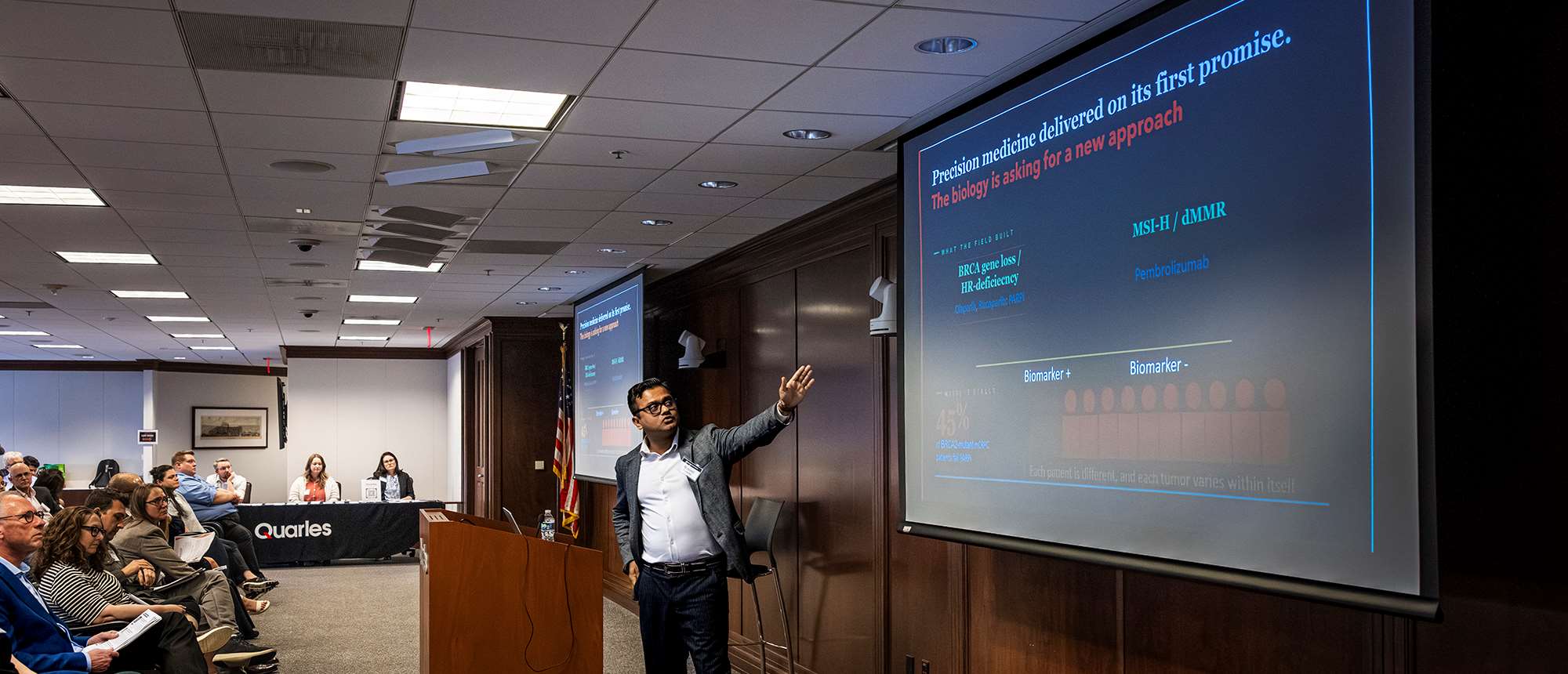
When Navonil De Sarkar, PhD, took the stage at Milwaukee's First Look Forum this spring, he had a lot more on his mind than the healthcare tool he was there to pitch.
The First Look Forum is an annual event that connects Milwaukee-area inventors and entrepreneurs with potential investors, and Dr. De Sarkar, an assistant professor in the Medical College of Wisconsin's (MCW) Department of Pathology and Laboratory Medicine, was selected as one of roughly 10 innovators to present.
His starting point was CHIMERA-DDR, a computational platform he and his team had developed and patented with help from MCW's Office of Technology Development. The platform gives clinicians a more nuanced picture of tumor biology for more precise treatment.
But the bigger story he wanted to tell was about where the science could go – a future in which cancer is tracked in real time from the bloodstream rather than checked on episodically through biopsies and scans.
"We envision a future where cancer is monitored in real time – on demand, 24/7," he says.
DNA Repair Deficiencies
Dr. De Sarkar's scientific journey began with years of deep exploration of advanced prostate cancer at the molecular level, which would eventually lead him to envision cancer through a different lens – and ultimately give rise to the CHIMERA-DDR concept.
His work in this area started when he became a postdoc in the lab of Peter S. Nelson, MD, at Fred Hutchinson Cancer Center in Seattle. There he helped establish that roughly 20 percent of patients with metastatic disease carry DNA repair deficiencies.
This molecular characteristic was detectable through biomarker testing, which looks for biological signals in a tumor that can predict how a patient will respond to certain treatments with DNA damaging agents.
Identifying that subset was important because those patients now have FDA-approved options tailored to their tumor's specific vulnerability. Those therapies include PARP inhibitors, which exploit the tumor's broken repair machinery to kill cancer cells, and platinum-based chemotherapy, which works by a similar principle.
A Complicated Picture of PARP Inhibitor Resistance
Yet the more Dr. De Sarkar studied these patients, the more he saw the limits of the approach. Clinicians were essentially asking a yes-or-no question – does this patient have a DNA repair deficiency? – when the biology was more complicated.
A tumor where 60 percent of cells have a complete deficiency and 40 percent remain intact will respond very differently to PARP inhibitors than one with deficiency spread uniformly across all cells.
That intact 40 percent might not respond to treatment, Dr. De Sarkar says; it survives, repopulates, and the cancer returns, often worse than before.
"We're seeing underperformance even within biomarker-positive patients, and we're missing treatment opportunities in patients currently labeled biomarker-negative,” he says. “That gap is what we're trying to close.”
Using CHIMERA-DDR to Analyze Tumor Samples

Dr. Navonil De Sarkar discusses a new computational platform with investors at Milwaukee's First Look Forum. The platform, developed by his lab, gives clinicians a more nuanced picture of tumor biology for more precise treatment.
To help close it, Dr. De Sarkar and colleagues, including Deepak Kilari, MD, an associate professor in MCW's Division of Hematology and Oncology, analyzed genomic and transcriptomic data from approximately 700 prostate tumor samples.
From those tissues, they extracted 94 distinct molecular features that together paint a continuous picture of a tumor's DNA repair landscape – capturing how much deficiency is present, what type, and whether repair-intact cell populations are lurking within an otherwise deficient tumor.
They feed those features into CHIMERA-DDR and it produces an integrated score that clinicians can use to make more targeted treatment decisions.
Step-by-Step Guidance from MCW’S Office of Technology Development
To protect and commercialize the tool, Dr. De Sarkar turned to MCW's Office of Technology Development.
"I came to them with an early rough concept," he says, "and they guided me through every step – evaluating its novelty, its commercial potential, getting to the provisional patent."
The office also connected him with a commercialization mentor, Scott Bolte, a former founder with experience in the healthcare industry, who independently reviewed the technology.
Finally, they also helped Dr. De Sarkar sharpen his pitch for the non-technical audience at First Look.
"They kept reminding me to speak like a generalist and not get bogged down in technicalities," he says.
Reading the Tumor from the Blood
Years spent at Fred Hutchinson Cancer Center working in prostate cancer genomics and developing liquid biopsy tools gave Dr Sarkar the scientific foundation he needed.
There, he and his co-authors demonstrated that molecular footprints left by tumors in the bloodstream can reveal the transcriptional activity of advanced prostate cancer – essentially reading the tumor's behavior from a blood sample rather than a biopsy.
Later at MCW, as an independent investigator, he began envisioning an entirely new approach. His lab is now developing methods to combine two types of molecular information that tumors shed into the bloodstream – free-floating DNA fragments and tiny membrane-wrapped packages called extracellular vesicles that carry proteins and other cellular cargo.
Information from those sources will allow him to reconstruct a picture of tumor biology comprehensive enough to give clinicians dimensions previously visible only through tissue biopsy, but now updatable as often as a patient can give a blood sample.
The long-term goal, he said, is something like a wearable or minimally invasive device that could tell a patient in remission whether they're truly cancer-free, flag early signs of recurrence months before a scan would catch them, or reveal whether a cancer under treatment is quietly evolving new molecular paths toward resistance.
"Right now, a patient has surgery and years later, after a period of remission, they suddenly find out the tumor is back," Dr. De Sarkar says. "During all that time, they're not having restful nights. Why can't we give them something that just keeps telling them you're doing fine?"


