

AI Digest
This section highlights information and articles related to artificial intelligence use in health sciences education.
Syllabi Policies for Generative AI Use
Dr. Lance Eaton of Anchor Insights Consulting maintains and publishes a crowdsourced spreadsheet of course-level policies for generative AI use to aid programs and instructors in developing their own policies.
MCW Resources | Search “AI” on InfoScope to learn more
MCW program and course policies should be mindful of the institution’s guiding principles, which are reviewed and updated on a regular basis.
EdTech: Focus on Higher Education published an article in December 2025 outlining how leaders in higher education are using AI in the classroom.
Highlights:
- Concerns regarding AI use in education include time, erosion of critical thinking, faculty overwhelm, and data and privacy issues.
- Incorporating AI into academia should focus on strong pedagogy and viewing it as a tool that can augment existing labs and lectures.
- Identifying existing student behaviors helped faculty view responsible AI use as a response to actual student habits.
- Faculty are finding ways to incorporate AI in a way that strengthens rather than competes with existing teaching approaches.
- Faculty are using AI to provide structure for assignments and identify potential curriculum gaps.
- The key is in starting small and finding moments to incorporate AI as a pedagogical partner.
- Examples of AI incorporation include using it to give guiding questions rather than answers, creating simulated experiences for learners, and scaffolding learning experiences for knowledge and skill development.
The Association of American Medical Colleges (AAMC) hosts a “AI Skill Building for Medical Educators” webinar series. The January 2026 session focused on AI integration into clinical education. CME credit is available for this webinar.
Objectives:
- Describe the potential impact of AI on clinical practice and diagnostic reasoning including risk of deskilling, never skilling, and mis-skilling.
- Explore AI applications for clinical care and strategies for their use in clinical education including strategies to assess readiness and evaluate outcomes.
- Highlight ethical and practical considerations for the physician-patient and human-computer relationships.
- Identify how teachers can incorporate adaptive learning skills and reflective practice to support thoughtful and safe expansion of AI in clinical practice.
View the "Preparing for AI Integration in Clinical Education" webinar
Dr. Rubin Pillay from the University of Alabama at Birmingham authored a white paper to serve as an evidence-based guide for health professions educators to navigate incorporation of AI into their teaching. It addresses both “training in AI” and “AI in training.”
The guide is organized into six parts:
- Foundational Competencies for the AI-Enabled Health Professional
- The AI Revolution in Medical Education: Current Applications
- Responsible And Ethical AI In Health Professions Education
- Pedagogical Strategies and Curriculum Implementation
- Overcoming Challenges and Ensuring Quality
- The Future Of AI in Health Professions Education
Download the Comprehensive Educator's Guide for AI in Health Professions Education (PDF)
The American Medical Association’s ChangeMedEd® Group has created a series of modules introducing key concepts in AI and health care. These modules are free of charge and can provide a foundation for understanding that aids us in preparing our students to use AI in practice.
- Introduction to Artificial Intelligence (AI) in Health Care
- AI in Health Care Methodologies
- The Use of AI in Diagnosis
- AI for Prognostication and Treatment
- Practical Applications of AI in the Health System
- Navigating Ethical and Legal Considerations of AI in Health Care
- AI and Precision Health
The Association of American Medical Colleges (AAMC) Group on Educational Affairs has compiled a list of competencies for medical educators in working with AI.
- Understanding AI
- Working with AI
- Critical Appraisal of AI Outputs
- Ethical Use of AI
- AI Possibilities in Medical Education
- AI Enhanced Clinical Encounters
- Using AI in Research and Scholarship
- Continuous Professional Development in AI
Learn more about AI competencies for medical educators (PDF)
The Association of American Medical Colleges (AAMC) offers a six-step process to support medical educators in the selection and implementation of AI tools for content creation.
- Identify educational goal
- Choose content format
- Plan deployment
- Inventory and govern sources
- Match AI tools to task
- Build a “Create-Convert-Collaborate” workflow
The framework seeks to reduce confusion and uncertainty through practical guidance and decision-making structures, providing guidance on leveraging AI for teaching, assessment, and student support.
View/download the Systematic Tool Selection and Implementation Guide (PDF)
The Association of American Medical Colleges (AAMC) offers seven principles for responsible use of AI in medical education. These principles reflect the dynamic nature of the AI environment and will be updated as needed. See the link below for more information on these principles.
- Maintain a human-centered focus
- Ensure ethical and transparent use
- Provide equal access to AI
- Foster education, training, and continuing professional development
- Develop curricula through interdisciplinary collaboration
- Protect data privacy
- Monitor and evaluate
The ETHICAL Principles AI Framework for Higher Education was developed by a team at California State University. The framework is meant to provide a foundation for responsible AI use in higher education that is flexible and adaptable to a diverse array of circumstances. We encourage members of the MCW community to become familiar with this framework, apply it to their own use of AI, and engage in conversations around responsible use of AI in health sciences education.
E – Exploration and Evaluation
T – Transparency and Accountability
H – Human-Centered Approach
I – Integrity and Academic Honesty
C – Continuous Learning and Innovation
A – Accessibility and Inclusivity
L – Legal and Ethical Compliance
“A new Academic Medicine commentary by Alison Whelan, MD, AAMC Chief Academic Officer, and Lisa Howley, PhD, Senior Director, Transforming Medical Education, draws parallels between early skepticism of the World Wide Web and current hesitations about artificial intelligence (AI) in medical education. Concerns about misinformation, equity, and the role of educators echo debates from the 1990s, yet AI holds promise to accelerate competency-based medical education through adaptive, data-driven learning. The authors call for a national set of AI competencies to ensure learners and faculty can evaluate tools, use them ethically, and understand their societal impact. Building on this call, the AAMC – supported in part by the Josiah Macy Jr. Foundation – will launch a new effort to define AI competencies across the continuum of medical education, drawing from leading frameworks and community consensus.”
Read the full text on the Academic Medicine website if you have a journal subscription or through MCW Libraries.
Learn more about AAMC's Artificial Intelligence and Academic Medicine resource
The Artificial Intelligence at MCW InfoScope page provides a variety of resources to educate and support members of our institution on responsible, effective use of AI. (MCW credentials required to access.)
Highlights:
- MCW Guiding Principles for the Responsible Use of Artificial Intelligence
- Microsoft Co-Pilot information, recommendations, and tips and tricks
- Educational videos from the University of Pennsylvania
- FAQs
Search “AI” on InfoScope to learn more.
MCW released guiding principles for artificial intelligence use in April 2024. The principles are applicable to all faculty, staff, and students conducting MCW business in any of the four missions. The core of these principles is engaging in human-centered AI, with transparency being crucial to fostering open communication around AI use and decision making.
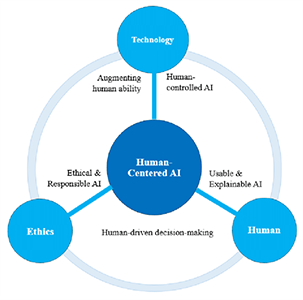
Figure: The Human-Centered AI (HCAI) framework with specified design goals
Additional information
Highlights from MCW’s Guiding Principles:
- In the absence of a formal contract, treat all AI tools as public.
- Never enter protected information into a public AI model.
- Review AI outputs for accuracy and employ responsibility in its use.
- Cite AI outputs and use as appropriate.
- Remember that AI is a tool and is not meant to replace human wisdom and judgement.
Search “AI” on InfoScope to learn more.