
In New Study Researchers Connect Polyploidy in Heart Muscle Genes to Worse Outcomes

Drs. Caitlin O’Meara, Amirala Bakhshian Nik, Alexandra Purdy, and Michaela Patterson (left to right) published a new study that explores the effects of polyploidy – a genetic condition – on heart failure.
Many people who suffer heart attacks will develop heart failure within three months, while others fully recover.
At the Medical College of Wisconsin (MCW), researchers are examining the cells, mechanisms, and genetic processes within the heart to better understand what leads to these divergent outcomes.
One condition that could affect outcomes is polyploidy – when cells within the body replicate their DNA but then fail to divide, therefore retaining the duplicated genetic material and causing genomic instability.
This cell state, found in all mammals, is especially common among cardiomyocytes, the muscle cells of the heart. But just how that polyploidy correlates with heart function remained unclear to scientists.
To connect the dots, an MCW research team harnessed the power of a unique new genetic research tool developed at the institute to determine which genes are associated with polyploidy.
They found that rat models with more heart cells carrying extra copies of genetic material had worse cardiac function.
They also found that one particular gene had several mutations that were associated with this condition. Experiments showed that variants of this gene damaged protein function within the heart.
“The results show that increased prevalence of polyploidy could be an early indicator of cardiac dysfunction,” says Michaela Patterson, PhD, associate professor of cell biology, neurobiology and anatomy and a co-author of the research.
“Understanding the genetic regulators behind this could lead to new diagnostic or predictive tests in the clinic,” says Caitlin O’Meara, PhD '11, associate professor of physiology and co-author of the research.
The results were published in a special issue of the Proceedings of the National Academy of Sciences that focused on polyploidy.
Understanding the Genetics of Polyploidy
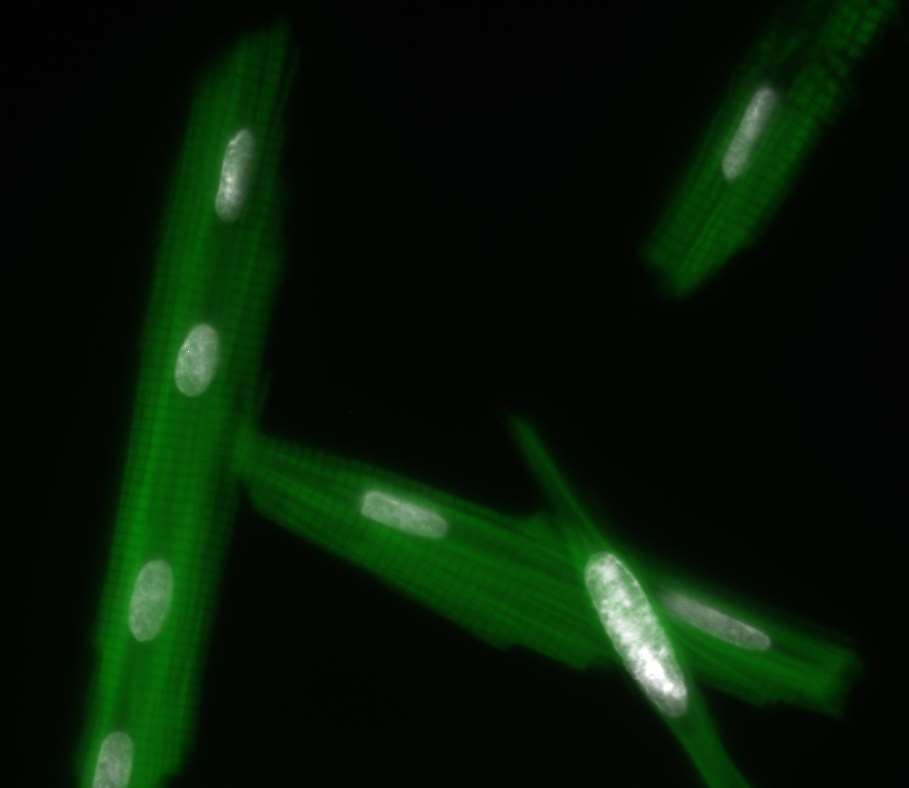
Image of polyploidy cells.
While polyploidy is common – so common that scientists believe it is necessary for growth and development, though they aren’t exactly sure why – cells that duplicate their DNA several times are less common.
To study these cardiomyocytes with up to 16 copies of their DNA – a condition called hyperpolyploidy – the research team used the Hybrid Rat Diversity Panel, an MCW tool developed by Melinda Dwinell, PhD, professor and eminent scholar of physiology. The panel includes up to 96 rat strains that scientists can use to map traits onto genes.
“Each of the strains is genetically different, and we’ve sequenced their genomes, so it’s a really great resource for identifying potential genetic associations,” Dr. Patterson says.
To find out which genes are associated with polyploidy in cardiomyocytes, former MCW graduate student Alexandra Purdy, PhD ‘25 collected heart muscle cells from the rat models and stained them. This allowed her to quantify the DNA content within each cell, which determines the polyploidy for each strain.
“Being able to use a resource that has this sort of genetic diversity allows us to investigate questions among different genetic backgrounds to understand how genetics influences disease,” says Dr. Purdy, who is now a research scientist at MCW.
When the team imaged the hearts of rat models that showed more hyperpolyploidy, they found those models had worse heart function – specifically, more left ventricular dilation and reduced ejection fraction.
To find out what genes might be involved in hyperpolyploidy, the team performed genome-wide association mapping with collaborator Laura Saba, PhD, a biostatistician and associate professor of pharmaceutical sciences at the University of Colorado.
“We wanted to make sure that genetics were involved in the presentation of hyperpolyploidy, and indeed they were,” Dr. O’Meara says.
While the team found that several genes were involved, one candidate stood out: Shroom3, a protein-encoding gene that is hypothesized to be involved in regulating cell shape.
To better understand what effect the gene had, the team studied mouse models that had the Shroom3 gene knocked out. Those mouse models showed more hyperpolyploidy in their cardiomyocytes and had worse cardiac function. The team, which included postdoctoral researcher Amirala Bakhshian Nik, PhD also identified a variant of the gene that influenced DNA replication in cardiomyocytes.
“For the first time, we're able to show that this gene is indeed involved in not only cardiomyocyte polyploidy, but also heart function,” Dr. O’Meara says.
A Tool for Understanding Disparate Outcomes after Heart Attacks
This is the first study to use the Hybrid Rat Diversity Panel, developed by Dr. Dwinell and her team over the past several years.
“Rats are ideal models to study certain diseases, including cardiovascular disease,” Dr. Dwinell says. “The results of this paper are exciting both in terms of cardiomyocyte polyploidy but also demonstrating how powerful the Hybrid Rat Diversity Panel can be in finding genetic regulators of common, complex disorders.”
Next, the team will examine how variants of Shroom3 influence heart failure to better understand why some patients have better outcomes after heart attacks. Dr. Patterson’s team is taking a systems biology approach by performing single-cell RNA sequencing across the rat panel to connect mutations to how a gene is expressed.
“The Hybrid Rat Diversity Panel will continue to be an incredible resource for bigger, greater questions of disparate outcomes after heart attacks,” she says.
Additional MCW researchers who contributed to this research include Anooj A. Arkatkar, Prottoy Hasan, Michael A. Flinn, Priyanka Choudhury, Akiko Takizawa, Lynn Malloy, Monika Tutaj, Brian A. Link, and Anne E. Kwitek.
Recommended


