Medical Students Present Radiology Research at a Global Alzheimer’s Conference
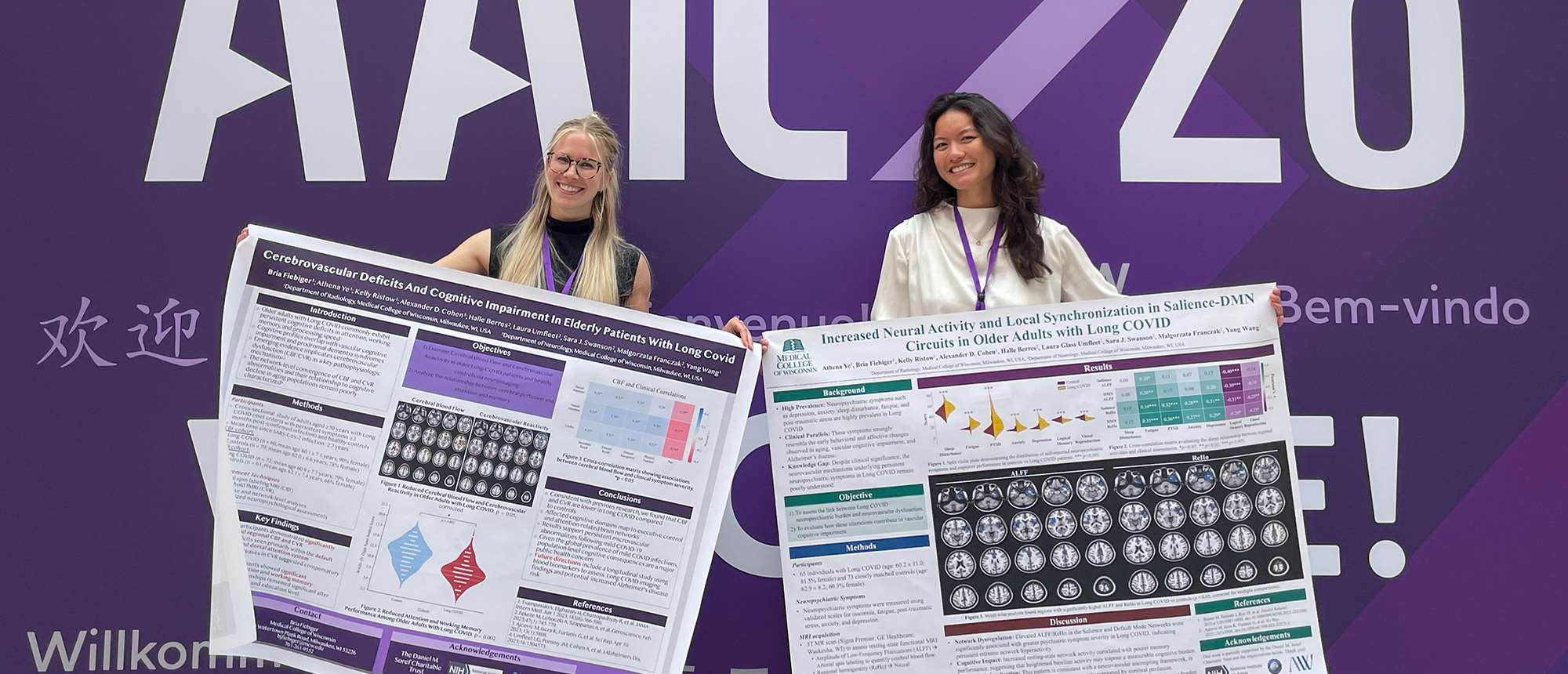
As first-year medical students, Bria Fiebiger (left) and Athena Ye traveled to London to present their research on Alzheimer's disease at an international conference. Their experience reflects MCW’s commitment to investing in early research for medical students.
Last fall when Bria Fiebiger was a first-year medical student at the Medical College of Wisconsin (MCW), she contacted Yang Wang, MD, PhD, professor of radiology, about openings in his lab. She thought he would be hesitant because of her limited research experience.
That assumption was far from the truth. Dr. Wang replied almost immediately, asking if she could meet that day. After their conversation, Dr. Wang offered Fiebiger a position in his lab.
About a week later, Athena Ye, then a first-year medical student, also joined Dr. Wang’s lab. At the time, she didn’t know Fiebiger or her open-arms welcome from Dr. Wang. As a former student athlete, she was drawn to the Wang lab’s research on traumatic brain injuries.
While that research project was fully staffed, Dr. Wang offered them a project on cognitive impairment, which they both accepted.
“What’s so great about Dr. Wang’s mentorship philosophy is that he is willing to set us up with a strong foundation while giving us the independence to make the work our own,” says Ye. “Rather than asking us to start over simply because we were new to the group, he gave us this wealth of data and encouraged us to take a hold of it and create a project out of it.’”
Dr. Wang’s early investment in Fiebiger and Ye paid off. In July, they each presented their first-author studies at the 2026 Alzheimer’s Association International Conference, the world’s largest Alzheimer’s-related research gathering.
Commonalities Between Long COVID and Alzheimer's
The conference was held in London, attracting more than 13,000 clinicians and researchers from more than 100 countries. Fiebiger and Ye’s day started off with a ride on the famous London Tube, a moment of calm before their poster presentations.
Fiebiger and Ye’s projects use the same study population: older adults with and without long COVID. Long COVID is a lingering after-effect of a COVID-19 infection, marked by fatigue, brain fog, and psychiatric concerns – symptoms shared by patients with Alzheimer’s disease and other neurological conditions.
Ye discovered that individuals with long COVID showed an increase in brain activity – their neurons fired more than average. Typically, when the brain becomes more active, nearby blood vessels respond by delivering oxygenated blood.
Fiebiger's project built on Ye’s study. She found that, counterintuitively, the more active brain regions in this population had less blood flow.
These brain regions are known to be important in supporting cognitive and emotional health. Consistent with these findings, those with long COVID were more likely to have depression, impaired memory and attention, and sleeping problems, among other neuropsychiatric symptoms.
“Think of your brain as a car engine,” says Ye. “Your brain is revving its engine trying to get more activity, which is the biomarker I looked at. But, for some reason, the car can’t get enough gas, or blood, into the engine. That’s Bria’s biomarker, reduced blood flow.”
Together, their research suggests that non-invasive imaging like MRIs may be able to identify brain changes associated with cognitive decline before the symptoms become too debilitating. These changes may also be a site for targeted therapeutics to buffer the cognitive and neuropsychiatric impairments in those affected by long COVID and Alzheimer’s-related diseases.
During the conference, a man approached Fiebiger and Ye, curious about their research. He shared that his relative has long COVID and had experienced symptoms so severe they lost their job.
“He told us about his relative’s story and it really stuck with us,” says Fiebiger. “The groups that we study are not just a population data set. They’re not just numbers. They are real people that are experiencing real symptoms.”
Early Clinical and Translational Research Opportunities for Medical Students
Fiebiger and Ye’s presence at the conference reflects MCW’s investment in early, impactful research experiences for medical students. Through the Medical Student Summer Research Program, the largest of MCW's Summer Academic Programs for Medical Students (SAMS), first- and second-year students are embedded directly into the laboratories of full-time faculty investigators as working members of the research team. The program is designed to expose students to cutting-edge basic science, clinical and translational research. Publishing and presenting are among its central goals.
Fiebiger and Ye say Dr. Wang fully embodies this mission and encouraged them to showcase their work in their first year.
“As medical students, we were in the minority at the conference,” says Fiebiger. “Most presenters were completing PhDs or different programs.”
“Dr. Wang allows us to be ourselves while also pushing us to be the best that we can be,” says Ye, also acknowledging the support and team-first mentality from the other medical students, postdoctoral researcher, and research technician in the lab.
This summer, Fiebiger continued her research in the Wang lab through a full-time, paid summer fellowship supported by SAMS. Ye also participated in SAMS, conducting research in a different lab while remaining active in the Wang lab.
Throughout the rest of medical school, Ye plans to continue her journey toward becoming a physician-scientist. Fiebiger is also interested in a career that involves research, likely in the field of diagnostic radiology. She will be following in the footsteps of her brother, who is a resident in the specialty at MCW.
“Getting involved in research adds so much more to who you are as a student,” says Fiebiger. “It lets you network with colleagues and peers, introduces you to opportunities like international conferences, and helps you grow professionally.”
“Bria and Athena’s experience demonstrates what is possible at MCW when motivated students, dedicated mentors, and a supportive institution come together,” says Dr. Wang. “I am grateful that MCW provides structured pathways that allow students to explore their interests, engage in scholarship, and pursue ambitious goals early in their medical education.”
MCW Medical School Admissions FAQ
MCW offers many program options to help you become the next generation of physician leaders. Here’s what you need to know if you are interested in applying to the MCW Medical School.


