

A New Strategy to Disrupt Bioenergetics in Parasitic Nematodes
A collaboration among researchers in the MCW Departments of Biophysics (Balaraman Kalyanaraman, PhD, the Harry R. & Angeline E. Quadracci Professor in Parkinson’s Research; (Gang Cheng, PhD, assistant professor) and Medicine (Michael Kron, MD, professor), and Aix-Marseille University in France (Micael Hardy, PhD) resulted in a new publication titled “Mitochondria-targeted agents disrupt bioenergetics in parasitic nematodes” in Archives of Biochemistry and Biophysics.
Mitochondria are critical for energy production and survival for parasites. The Kalyanaraman laboratory has pioneered the development of agents that specifically target mitochondrial respiratory complexes (e.g., mitochondria-targeted honokiol, mitochondria-targeted atovaquone). In this study, the co-authors used these compounds in submicromolar concentrations to disrupt the mitochondrial function of parasitic nematodes (Brugia malayi and Dirofilarial immitis, commonly known as heartworm). Dirofilaria, a blood-borne parasite transmitted by mosquitoes, infects dogs, cats, and other mammals. If untreated, severe cardiopulmonary problems arise ultimately resulting in death. Standard treatment for dog heartworm combines melarsomine, arsenic-based adulticide, and an antibiotic. Although these drugs are effective, they exert considerable side effects. Mitochondria-targeted honokiol is >200-times more effective than melarsomine in inhibiting mitochondrial respiration of parasitic nematodes. It is plausible that this strategy may lead to more effective and less toxic antiparasitic drugs.
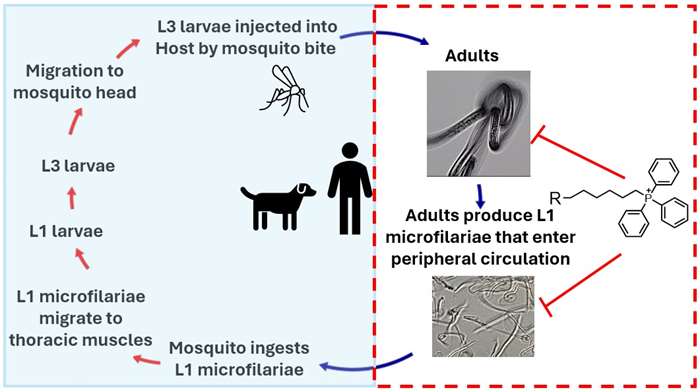
The above image shows the life cycle of B. malayi and D. immitis and the proposed intervention periods of the mitochondria-targeted agents.
The co-authors have filed a provisional patent for this technology with the help of Landon Olp in the Office of Technology Development.