
Assessing Alcohol Risk
There’s a lot of news about alcohol these days. Research over the last decade is showing that even small amounts can increase your risk of cancer as well as other injuries and health conditions. The most recent guidance says to “drink moderately.” While moderation is a vague term and means different things to different people, the information here can give you a risk assessment.
Understanding Standard Drink Sizes
Many people are unaware of what counts as a standard serving of alcohol. In recent years, drink containers have become larger and stronger, making what looks like a single serving far more alcoholic than expected. Understanding how big a standard drink is can help people more accurately assess the risk alcohol may pose to them.
What Is a “Standard Drink”?
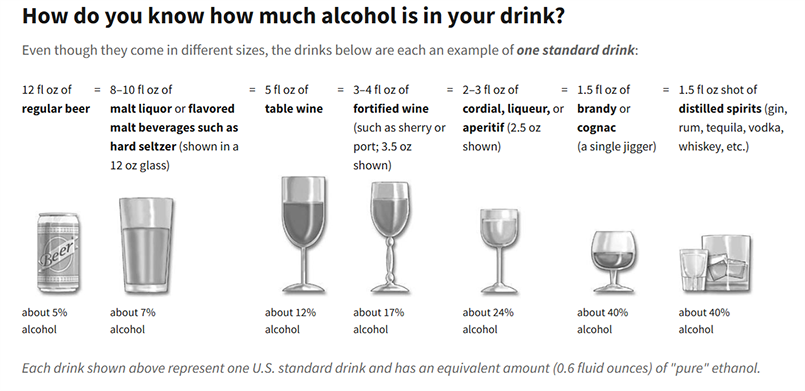
In the United States, a standard drink contains 0.6 fluid ounces (14 grams) of pure alcohol. This is the amount used in public health guidelines – not necessarily the amount poured into a glass or found in a typical beverage container.
Because alcohol levels vary widely, a standard drink is based on alcohol by volume (ABV):
- Beer (5% ABV): 12 ounces
- Stronger beer or wine (12% ABV): 5 ounces
- Fortified wine: 3–4 ounces
- Distilled spirits (40% ABV): 1.5 ounces
Why Standard Sizing Matters
- Most people pour more than these amounts at home.
- Many ready‑to‑drink beverages contain far more alcohol than expected.
- Some “alcopops,” for example, can reach 14% ABV and come in 24‑ounce cans, meaning a single container may hold five or more standard drinks.
- This means what appears to be “one drink” can actually deliver multiple servings of alcohol – making it easy to unintentionally consume unhealthy amounts.
What is considered safe?
Technically, there is no safe level of alcohol. Each drink contributes to a person’s lifetime risk of developing cancer, and if you drink two to three drinks per day, you could be damaging your liver. Drinking can make you more prone for injuries or to be a victim of violence.
The points below outline how risks increase with the more alcohol a person consumes:
- More than 7 drinks per week = 1 in 1,000 risk of alcohol-related death.
- More than 9 drinks per week = 1 in 100 risk of alcohol-related death.
- For men averaging 2 drinks per day = 1 in 25 risk of alcohol-related death.
How can risk be lowered?
- If you do not drink alcohol, do not start.
- If you do drink, cut back. Have alcohol free days. You’ll reduce the risk of harm to your health and lower injury risk.
Certain groups should avoid alcohol entirely, including:
- People who are pregnant or may become pregnant
- Anyone under 21
- People with certain medical conditions or taking medications that interact with alcohol
- People recovering from alcohol use disorder, or who struggle to limit drinking
- Individuals with a family history of alcohol-related cancers
Sources: Alcohol Intake & Health Study | Surgeon General's Advisory | World Health Organization Statement
Check Your Drinking | Make a Plan to Drink Less
Want to check your alcohol use? The Centers for Disease Control and Prevention (CDC) offers a quick assessment tool to help you check.
In The Community
Some alcohol serving establishments offer drinks that contain far more than a single standard serving. Oversized beverages – such as 48-ounce margaritas, fishbowl cocktails, “bottomless” specials, shared bowls, and other novelty drinks – can contain multiple servings of alcohol in a single container. Even when these drinks are marketed as “for the table,” each person drinking from them can become intoxicated quickly.
Why This Matters
When very large or high alcohol drinks are served, communities may see:
- An increase in law enforcement calls for service related to disturbances or intoxication.
- More OWI (Operating While Intoxicated) citations for individuals leaving certain establishments.
- Greater liability and potential consequences for licensed establishments that overserve customers.
- Scrutiny from local licensing committees, city councils, or county boards when alcohol related incidents cluster around specific businesses.
Considerations
It is illegal to serve alcohol to someone who is already intoxicated. Oversized drinks raise important questions about responsible service.
For example, what does it mean to sell a 96-ounce cocktail to one person?
The legal volume alone makes it difficult for servers to monitor consumption and prevent overservice.
Local Authority and Prevention Options
Municipalities have the ability to take proactive measures to protect community safety. They can:
- Place restrictions on how oversized alcoholic beverages are sold.
- Prohibit drink specials that steeply increase alcohol consumption or encourage fast consumption.
- Limit competitions or promotions that encourage drinking large quantities in a short time.
- These policies help reduce the risk of overservice, intoxication, and alcohol related harm within the community.
Alcohol Consumption Resources
Dietary Guidelines for Alcohol (CDC)
Facts about moderate alcohol consumption and non-drinking.
Drink Less, Be Your Best Communications Campaign (CDC)
A campaign that encourages US adults who drink excessively to drink less to improve their quality of life, relationships, and health.
View the Wisconsin community substance use services provider directory.