
MCW Researcher Gearing Up to Improve Technology That Reveals Protein Shapes
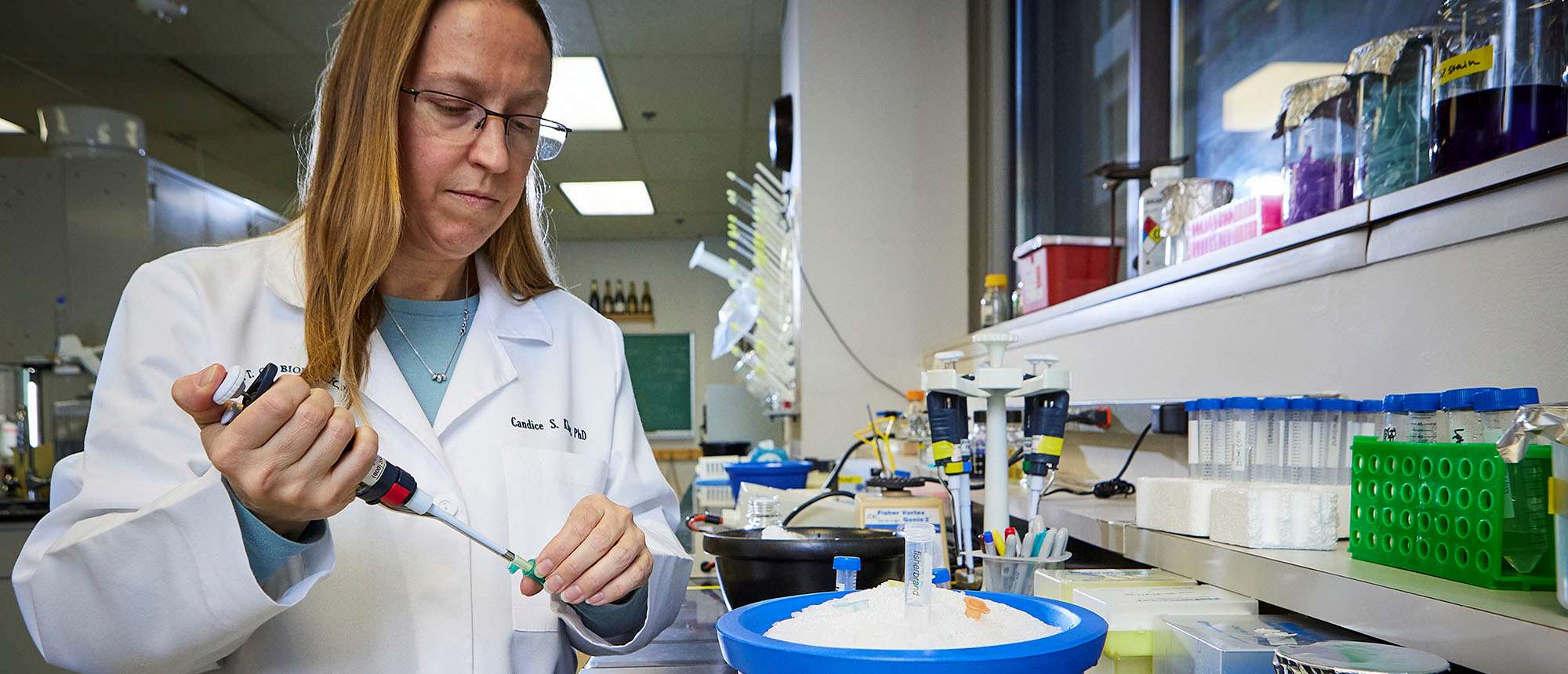
As a graduate student at the Medical College of Wisconsin (MCW), Candice Klug, PhD ‘99, now the interim executive vice chair and James S. Hyde Professor of Biophysics, studied a particular E. coli protein with an unknown shape. Scientists need to see a protein's shape to understand its function and to find new targets for drugs such as antibiotics that can kill the E. coli bacteria.
Such molecules are too miniscule to be viewed under a microscope, so researchers traditionally undertake a tricky process called crystallization: they grow the proteins into crystals then shoot x-rays at them, which bounce off the crystals to reveal the protein's 3D shape.
Dr. Klug, though, was using electron paramagnetic resonance (EPR) technology, which allows scientists to study a protein’s shape when it’s wet and flexible, like how it is in the body. With EPR, she attached tiny magnetic tags to specific parts of the protein then measured the distance between them to calculate its shape.
She identified a “beta strand” in the protein, a structure commonly seen in barrel-shaped proteins. It was an exciting find because it offered a strong clue of what the protein’s shape looked like, but Dr. Klug didn’t know that other scientists were working on crystallizing the protein.
“Just as I was writing my dissertation, we got a preview of the crystal structure and it was a little nerve-racking,” she says with a laugh. “But then it turned out that it all matched exactly, my data was reinforced by the crystal structure.”
A Russian Nesting Doll of Protein Discoveries
That moment sticks out in Dr. Klug’s mind some 25 years later. As the director of the National Biomedical EPR Center, one of the largest EPR facilities in the nation, she has spent her career probing the shapes of proteins in gram-negative bacteria like E. coli. Since such bacteria can become antibiotic resistant, understanding the function of specific proteins inside their cells could yield new ways to fight them.
Dr. Klug studies seven different types of proteins involved in the transport of a complex molecule called lipopolysaccharide (LPS). The seven proteins work to move LPS from one part of the cell to its final location on the outside of E. Coli and other bacteria. Here, LPS helps form the protective outer membrane that shields the cells from attacks by antibiotics.
If scientists could figure out a way to disrupt any of those proteins, the bacterial cells would die.
“Any one of them would be a fantastic new drug target if we could figure out how they work,” says Dr. Klug.
She uses EPR because it offers a better platform than crystallization for understanding how proteins work in the real world.
“Proteins are not normally in crystals when they function in our body,” she says. “I've based my research on looking at how they move in solution, when they’re flexible as they are in the body, rather than rigid crystals.”
Dr. Klug’s lab has made some important progress on understanding LPS transport proteins and she hopes to do more now that she’s been awarded a new five-year $2.22 million Maximizing Investigators’ Research Award (R35) grant to continue such research.
The grant will allow Dr. Klug to build on previous work. For instance, her lab has uncovered that one of the proteins, LptA, stacks together to make a bridge between the cell’s’ inner and outer membranes to help with the building of that protective shell.
They have also studied the LptB2FGC complex, which forms the starting point of the bridge and serves as a loading dock for LPS molecules as they begin their journey to the outer membrane.
Their work recently showed how the membrane portion of the LptC protein, which serves as a gateway to that loading dock, gets out of the way when the transport cavity closes.
“Knowing how that gatekeeper moves could help other researchers and pharmaceutical companies design a drug that would block LPS from entering the complex," Dr. Klug says, “That would prevent the formation of the bacteria's protective outer membrane and the cells would die.”
Understanding proteins is a bit like opening up a Russian nesting doll, she says, “each discovery raises new questions – the more we learn, the more we realize we don’t know.”
Enhancing EPR Through New Technology
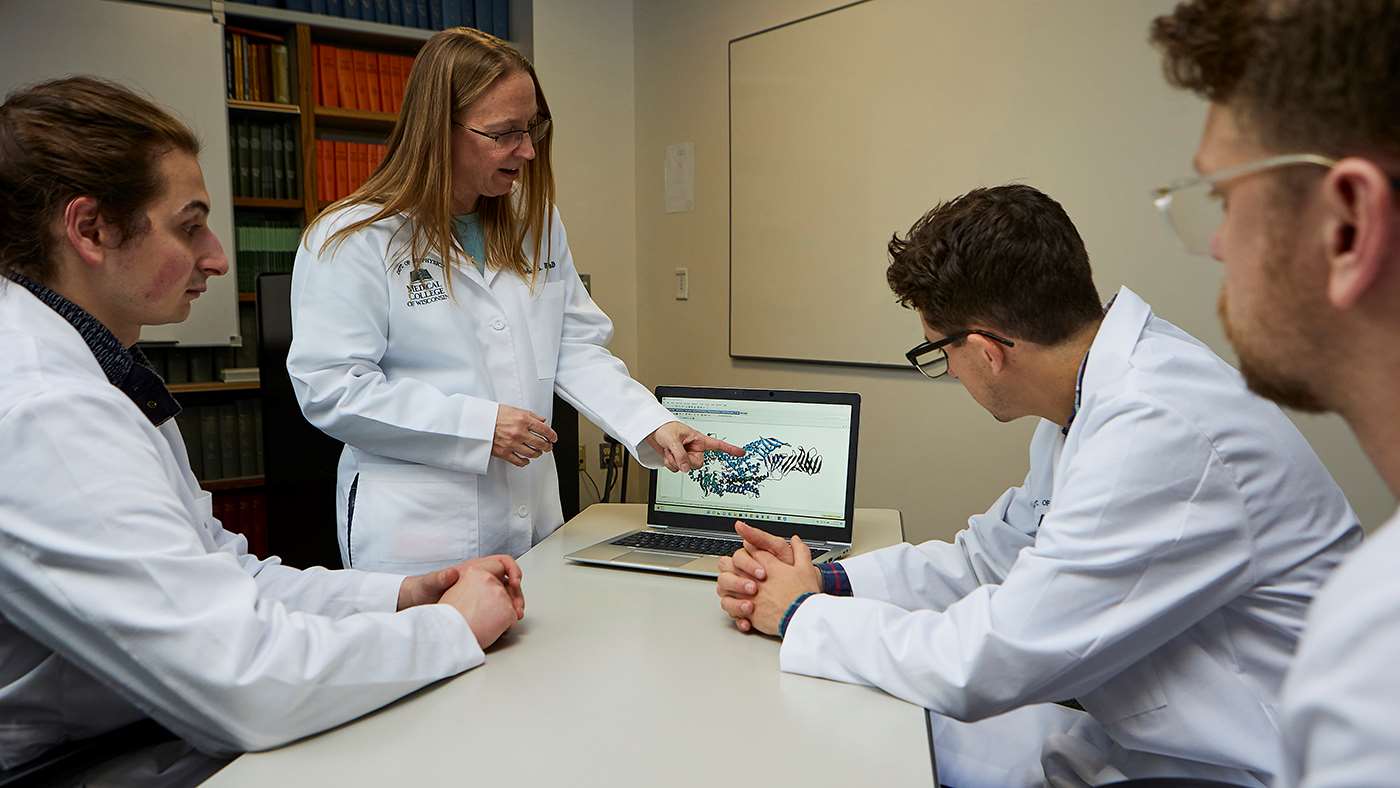
The Klug Lab works to identify the shape of proteins, which could lead to new drug targets for harmful bacteria such as E. coli.
Her research could be greatly accelerated by an array of new “enabling EPR technologies” that the new grant is also funding She, along with colleagues Michael T. Lerch, associate professor of biophysics, and Jason W. Sidabras, assistant professor of biophysics, want to make EPR technology more sensitive so it can pick up weaker signals.
To do that, they'll tweak the resonators – which create the electromagnetic field needed to make a sample respond and then pick up the signal that comes back – and are testing geometrically shaped sample tubes.
“Instead of a round tube, they have star designs or lumens that look kind of like a sun,” Dr. Klug says. “Just by doing that, we can increase our signal significantly.”
The team is also building high-throughput EPR systems that would create robotic sampling to test hundreds of samples overnight, which is especially exciting to Dr. Klug. Some of her research can take three days to run through the EPR “because you have to do every single sample manually.”
Automation could also expand EPR from something done mostly at research institutions to something useful to drug companies, allowing them to screen for and test all kinds of proteins as potential targets.
That would also bring Dr. Klug full circle. When she graduated from MIT with a bachelor’s degree in chemistry, she wanted to stay in Boston and work for a pharmaceutical company but was unable to find a job.
“So I came here and worked at MCW as a technician in the EPR lab to get some experience in the things those companies said they wanted,” she says. “While I was here, I ended up realizing that I really loved research and I enrolled in the PhD program. I’ve been here – happily – ever since.”
Recommended


