Testing Mindfulness to Improve Outcomes in High-Risk Pregnancies

Growing up the daughter of two physicians, it’s not surprising that Anna Palatnik, MD, GME ’13 chose medicine as a career. Her family emigrated from Russia to Israel, and, as a young girl, Dr. Palatnik watched her father, an OBGYN, and mother, a pediatrician, assimilate to a new country while dedicating themselves to the care of their patients.
Years later, after medical school at Tel-Aviv University, Dr. Palatnik decided to follow her father’s path, completing an OBGYN residency at the Medical College of Wisconsin (MCW), followed by a maternal-fetal medicine fellowship at Northwestern University.
 Then Dr. Palatnik returned to MCW, this time as a faculty member. Today, she is the Patrick J. and Margaret G. McMahon Endowed Chair in Obstetrics and Gynecology, where she treats patients with high-risk pregnancies and conducts research to improve outcomes for that population. She recently achieved national distinction, ranking #4 in the Blue Ridge Institute for Medical Research rankings within her field. Blue Ridge also ranked MCW's OBGYN department #16 nationally.
“Like my parents, I see my career in medicine as a privilege,” she says. “Patients put their trust in me and I help them with their medical problems.”
Most recently, her focus has been on holistic medicine, which led her to pursue a fellowship in complementary and integrative medicine (CAM) – a practice which combines alternative and holistic approaches to care with mainstream medicine. As part of her fellowship, she will launch a project testing whether mindfulness can lower high blood pressure in pregnant women.
The work will be funded with a $1.2 million National Institute of Health (NIH) R01 grant that Dr. Palatnik and her research partner and co-primary investigator, Margaret Bublitz of Brown University, were recently awarded.
In the study, the patients will wear smartwatches to record their heart rates and perform regular blood pressure checks while also receiving training in mindfulness techniques.
"It's a very exciting and meaningful project," Dr. Palatnik says, adding that her interest in non-medical health interventions came about because she realized: “I can’t solve everything with a pill.”
Pregnancy as a Stress Test
When Dr. Palatnik first joined MCW's faculty, she enrolled in the Clinical Research Scholars Program and received mentorship from senior faculty on grant-writing and developing research questions.
“That opened the door to several valuable interdepartmental mentorships,” she says, “and ultimately helped me secure funding for several clinical trials. It made a tremendous difference in my professional development.”
Those trials focus on improving outcomes in two high-risk pregnancy conditions: gestational diabetes and pregnancy-related high blood pressure such as gestational hypertension and preeclampsia.
Both of these conditions increase risk to a mother’s health during pregnancy. They can also have lingering effects on the mother’s body after the baby is born. Dr. Palatnik has another clinical trial looking at interventions to prevent the development of future cardiovascular disease following preeclampsia.
"We now know that pregnancy is a stress test. It reveals what a woman's body is at risk for long-term," she says. "For example, if someone has gestational diabetes, they have a risk of Type 2 diabetes later in life. If someone has preeclampsia, they are at high risk of chronic hypertension and earlier heart disease."
Advancing Maternal Health Equity
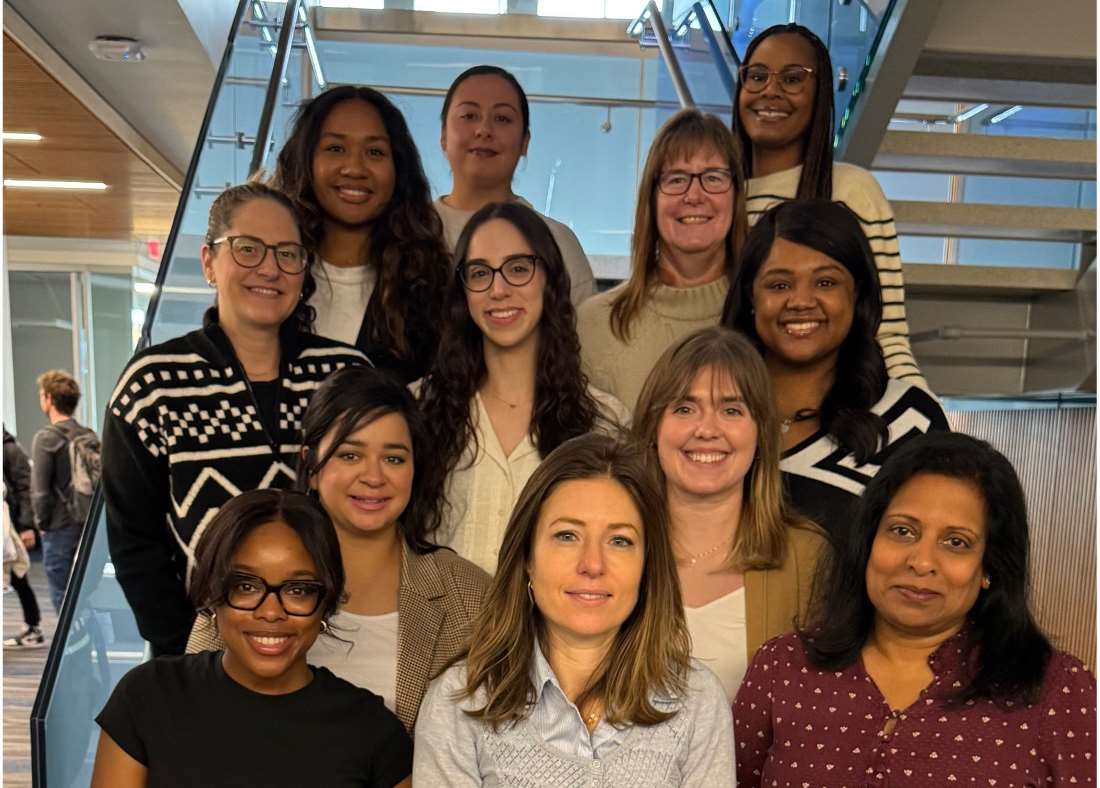
Dr. Anna Palatnik, MD, GME '13, (first row, center) with members of her lab.
The two conditions also disproportionately affect Black women, she says. Non-Hispanic Black women experience pregnancy-related mortality rates approximately 2.5 to 3 times higher than non-Hispanic White women, according to the CDC.
Dr. Palatnik wanted to do something about that so, in 2023, she joined other MCW researchers to apply for NIH funding to identify non-medical risk factors to promote maternal health equity and reduce disparities in maternal obstetric outcomes.
The group – which included Joni S. Williams, MD, MPH, from the Center for Advancing Population Science, and Jessica Olson, MPH ‘15, PhD ‘17, and Julia Dickson-Gomez, PhD, from the Institute for Health & Humanity – received $10.2 million from the NIH to study how housing stability and medical mistrust could affect Black women's maternal health and develop interventions to address these risk factors.
As part of the award, the NIH also designated MCW as a Maternal Health Research Center of Excellence.
For the medical mistrust project, the researchers partnered with the African American Breastfeeding Network to develop a collaborative community-based prenatal care model that would, among other things, train doulas to serve as liaisons between Black pregnant women and their doctors.
Dr. Palatnik says the aim of the project is to identify drivers of medical mistrust in African American pregnant women, improve their healthcare engagement, and reduce their pregnancy-related mortality rate.
“One hope is that the doulas can bridge gaps in trust by strengthening communication between patients and their healthcare team,” she says, "so that we can increase positive outcomes for at-risk patients.”
Helping Women Around the Globe
Her interest in helping underserved women has also become more global. She traveled to Nepal this year to set up a pilot project to test whether a particular biomarker in pregnant women’s blood could predict whether they develop preeclampsia postpartum.
Dr. Palatnik says she is grateful for the help she received from Tifany Frazer, MPH, director of MCW’s Office of Global Health, and Laura Cassidy, MS, PhD, director of the Institute for Health & Humanity. She says their efforts facilitated her travel to Nepal and helped her foster collaboration with local obstetrics and gynecology partners, including Dr. Abha Shrestha at Dhulikhel Hospital in Nepal.
"In Nepal there is a very high rate of preeclampsia, and women often live in rural areas far from their clinicians," Dr. Palatnik says. "If we can predict who might develop the disease after delivery, we can provide these patients education on what symptoms to watch for and send them home with blood pressure medicine and a blood pressure cuff.”
The opportunity to make a difference in pregnant women’s health – both near and far from MCW – to learn about complementary medicine, and to conduct clinical trials in maternal health medicine, shows the strength of MCW’s support for its faculty, Dr. Palatnik says.
“I’m really grateful to MCW for the role it’s played in helping me grow as a clinician-scientist,” she says. “The mentorship, collaboration, and support I’ve found here have opened so many doors and continue to expand what I’m able to do in my research and for my patients.”
Recommended


