Data Science Institute’s Monthly Coffee Hour Series Fosters Connections, Collaborations
The parents of Anai Kothari, MD, professor in the Division of Surgical Oncology at the Medical College of Wisconsin (MCW), might be clairvoyant.
How else did they know to include one of most transformative technologies of recent times – AI (artificial intelligence) – in his first name? And what else can explain how Dr. Kothari, would go on to perform research driven by that very phenomenon?
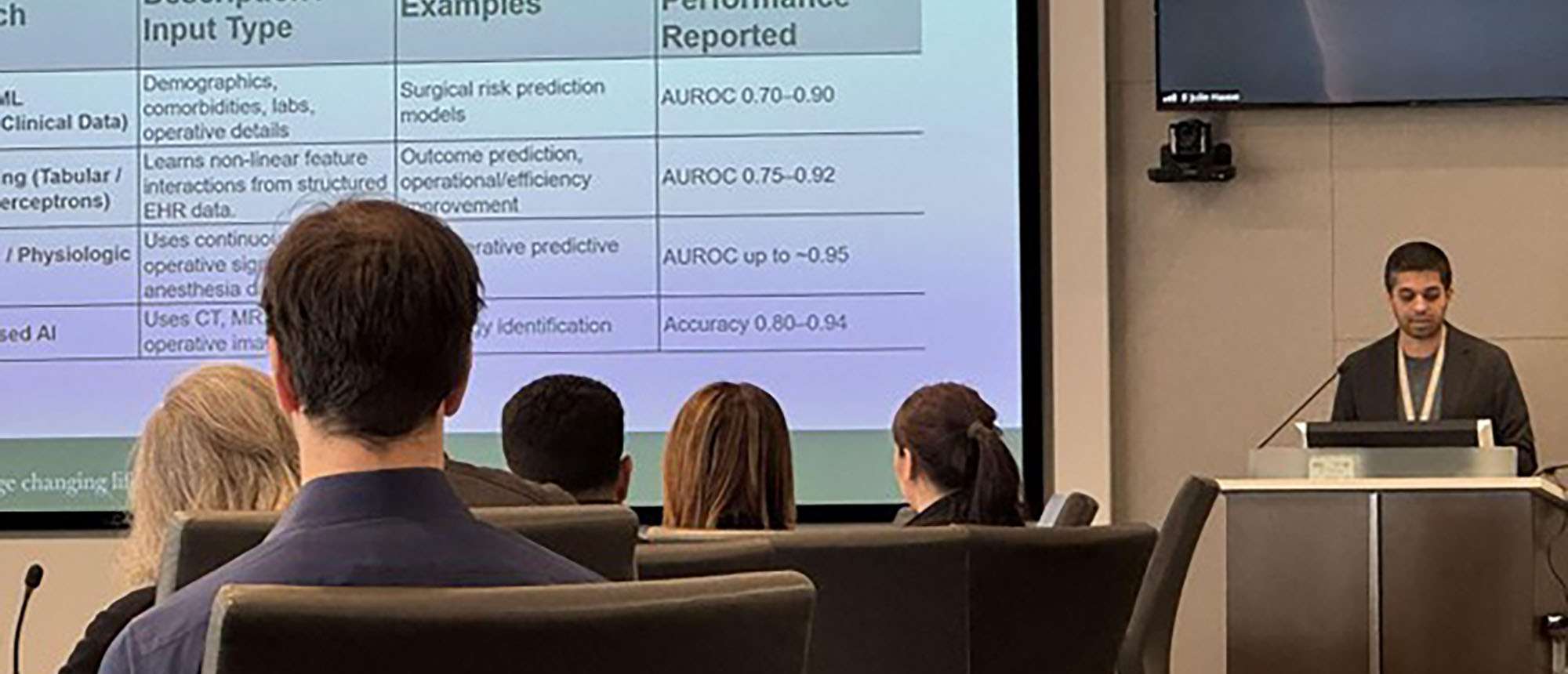
At least that’s what Dr. Kothari jokes in a research presentation given as a part of the Data Science Institute (DSI)’s recently-launched Coffee Hour Series.
The series, held the 4th Wednesday of every month, showcases innovative data science research happening around at the academic medical center. This research uses state-of-the art technology and advanced algorithms to bring clinical solutions to the bedside more quickly and effectively. Thanks to this tech, we are seeing more connections between AI and data science.
Past Coffee Hours have featured Tongjun Gu, PhD, adjunct assistant professor in the DSI, discussing how AI can aid in discovering biomarkers common in stem cell disorders, as well as Fabrizio Marinelli, PhD, associate professor in the Department of Biophysics, delving into how AI can help us understand the molecular underpinnings of cell membrane transport.
During Dr. Kothari’s recent talk, attendees learned how he applies artificial intelligence to solve real-world challenges in cancer care.
In one project, his team uses patient lab data to predict a key tumor marker that guides pancreatic cancer treatment, helping to personalize care for patients whose bodies do not naturally produce it. In another effort, the lab partnered with the Clinical & Translational Science Institute (CTSI) and the MCW Cancer Center Clinical Trials Office to develop an AI-driven system that matches patients to appropriate cancer clinical trials, streamlining enrollment and expanding access to emerging therapies.
“MCW is uniquely positioned with experts at the intersection of clinical care and data science,” says Kothari. “The Coffee Hour Series fosters collaboration and shared learning, and this accelerates ideas moving from concept to implementation. That's how we can turn scientific discovery into real impact for patients and their families."
After hearing from Kothari, attendees were able to ask questions and discuss the projects. This part of the event allows the clinicians, researchers, and students to learn from each other’s work and opens the door to potential collaborations.
“The value of the Coffee Hour Series lies in making new connections – it creates a casual environment where clinicians, basic scientists, and data experts all collide,” says Nick Semenkovich, MD, PhD, physician in the Division of Endocrinology and Molecular Medicine, who participated in the event.
“MCW is generating world-class data but transforming that data into clinical solutions requires a robust and innovative computational culture. The Coffee Hour Series humanizes that infrastructure,” says Dr. Semenkovich, who is also a scientist in the DSI, which he co-founded.
“The Coffee Hour Series aligns with DSI’s mission to foster a data-driven culture, create data science innovations, and generate synergistic research that will ultimately enhance patient care in our community and across the region,” says DSI Director William Hogan, MD, MS. “It builds on the collaborative nature of MCW and leads to connections that may not otherwise have occurred. We’re excited to offer this event to the MCW community.”
Recommended


