In Green Bay, Alumni Have Become ‘Part of the Community’
Ryan Berns, MD ’18, grew up in the Milwaukee area and got a Master of Public Health degree from the University of Wisconsin-Madison. When he considered medical school, he assumed he would attend in one of those two cities.
Yet, when he heard about the Medical College of Wisconsin’s regional Green Bay campus that was set to open in 2015, “it sounded like the perfect fit for me,” he says. Its specialized physician in the community pathway trained physicians to become an integral part of their communities, especially within Northeast Wisconsin.
“I always knew I wanted to keep an eye on both the pulse of the patient and the pulse of the community,” he says.
After graduating in MCW-Green Bay’s inaugural class in 2018, he did just that. He now lives in the Green Bay area, raising three children and practicing family and sports medicine.
In fact, Dr. Berns is part of a cohort of alumni who attended MCW-Green Bay – attracted by its small class sizes, personal interactions with preceptors, and accelerated three-year curriculum – and then stayed in the area to practice and become mentors to the next generation of MCW-Green Bay medical students.
Together they illustrate the achievement of MCW’s goal to become a national leader and role model for an immersive, community-based medical school program – both in Green Bay and at its other regional campus, MCW-Central Wisconsin – that helps retain talent in rural Wisconsin.
Working in the Community, Becoming a Mentor
Alyssa Reid, MD’19, grew up in northern Wisconsin and knew she wanted to stay close to family and friends during medical school.
 MCW-Green Bay fit the bill – especially the three-year program, which would allow her to start practicing medicine sooner. The experience was much more intimate and personalized than she initially imagined it could be.
“We had such a small cohort that we got to work one-on-one with doctors on every single one of our clinical rotations, which is really unique,” she says.
Even pediatricians outside of her formal rotations invited her to shadow them.
“I didn’t fully grasp how unprecedented that was until I did my pediatric residency afterward in a larger academic center, where there was a reporting chain of command among residents up to the attending physician,” she says.
She returned to Green Bay after her residency and is now a pediatrician who invites MCW-Green Bay students to join her for clinic rotations.
“My husband and I both practice medicine and, for us, Green Bay is a place where we're both able to have a career and it’s just a nice community to be a part of,” she says.
She also teaches The Good Doctor course at the school, which educates students about the ethics and emotions involved in practicing medicine. She enjoys giving back, especially since her medical school mentors had such an impact on her.
“It’s a great school, especially if you know you want to be in Wisconsin and practice primary care,” she says. “Even if you’re not sure what you want to practice, you can still specialize and achieve all of your career goals.”
Becoming a Family Practitioner in the Community
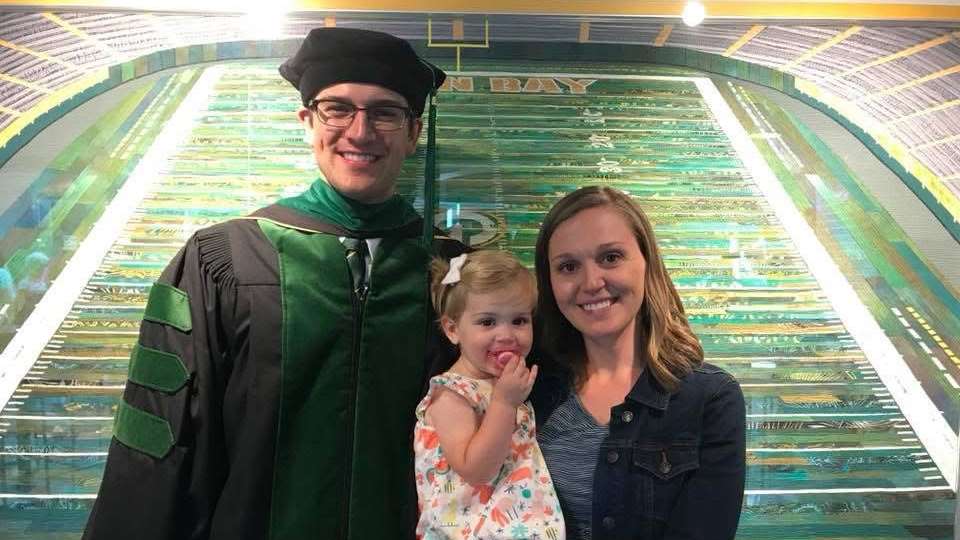
Ryan Berns, MD '18, with his family at graduation. Dr. Berns chose MCW-Green Bay because of its small class sizes, accelerated curriculum, and personal interactions with teachers and mentors.
Collin Hess, MD ’20, was no stranger to Green Bay – he grew up in the area and attended college at St. Norbert College in De Pere, Wisconsin, just outside the city.
“I had a lot of support here in Green Bay, so attending MCW-Green Bay worked out really well,” he says.
He knew from the get-go that he wanted to practice family medicine, and the school’s curriculum meant he could graduate “with a heck of a lot less debt.” As a student, he enjoyed hanging out with his small cohort – meeting up at the beach, or teaching anatomy to kids in the community.
“You get to know your classmates really well,” he says. “It’s a very close-knit community.”
His aspirations to practice family medicine were thrown into full gear when he had a child during medical school.
“It definitely changed my mindset and helped me talk with my patients about interventions that I had actually had hands-on experience with,” he says.
After a residency in Appleton, he returned to Green Bay to become a family medicine practitioner in the community.
“I get to see full families – the kids, the parents, the grandparents – and encounter so many different conditions,” he says. “Studies show that if you have better primary care, you have better health outcomes. It’s nice to be a part of that.”
Dr. Berns also had the experience of having a child during medical school – and was even there to help deliver her.
“You really do get clinical exposure at the elbow of your preceptors,” he says.
Dr. Berns also now mentors medical students in his practice, with the hopes that they, too, will learn the lessons that he did as part of the inaugural class.
“MCW teaches you not only to become a great physician, but how to be a great leader in the community,” he says.
MCW Medical School Admissions FAQ
MCW offers many program options to help you become the next generation of physician leaders. Here’s what you need to know if you are interested in applying to the MCW Medical School.
Recommended


