Pharmacy Student Builds a Career While Raising a Family
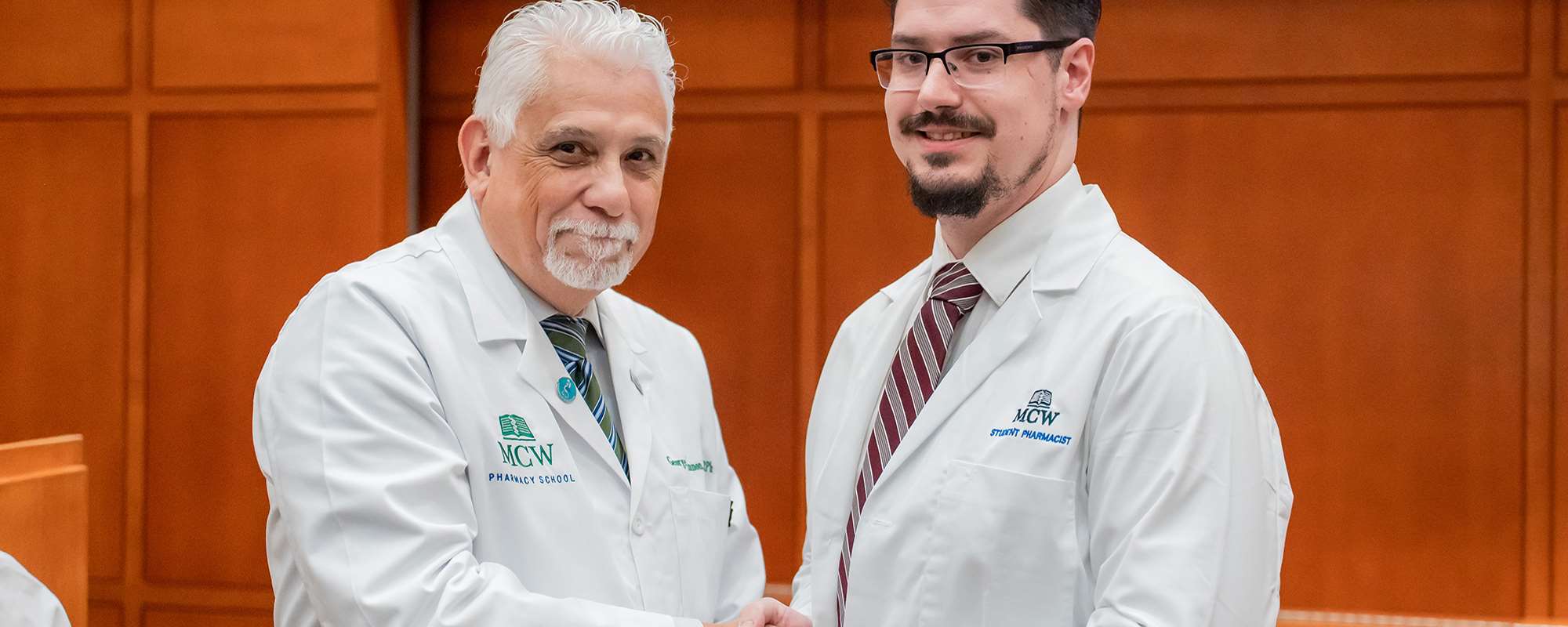
Stephan Noonen, first-year pharmacy student at the Medical College of Wisconsin (MCW), always knew one day he would wear a clinic ID badge, he just wasn’t sure what exact title would follow his name.
From childhood, Noonen was interested in becoming a physician, leading him to study biochemistry at Virginia Tech. A few years into his schooling, Noonen paused and considered whether other healthcare careers could also be a good fit.
To answer that question, he applied to several healthcare jobs after graduation, landing a role as a pharmacy technician in a mom-and-pop pharmacy in rural Virginia. The experience was eye-opening for Noonen, clarifying his career interests and revealing what string of letters would round out his badge.
“I realized I wanted to understand how chemicals enact a response in the body, which is why I enjoyed my biochemistry degree,” says Noonen. “More than that, I didn’t want a patient to take a medication simply because their doctor prescribed it, yet they had no idea what it’s called or what it does. As a pharmacist, I wanted to advocate for patients being involved in their own health.”
Finding Community and Expanding the Role of Pharmacists
 A year and a half into Noonen’s pharmacy technician role, a similar position opened in Madison, Wisconsin, at the city’s Veterans Affairs (VA) hospital. Noonen, who comes from a military family, recalled the compassion another VA hospital exhibited towards his sister while receiving treatment in the military. He decided to apply for the position.
Earning the role, Noonen re-located, which brought him near MCW and enabled him to enroll in the Doctor of Pharmacy Program. While traditional pharmacy programs are four years, MCW offers a three-year program, a feature that attracted Noonen because it meant reducing his student loan debt and time away from the job market.
While MCW’s program may be condensed, the sense of community remains strong. “Every professor, every person in all cohorts, including the medical students and Master’s of Anesthesia students, have all been super supportive, wonderful people,” he says. “Everyone is very willing to help each other in whatever way we can, which is also a huge support in an accelerated program.”
Outside of the classroom, Noonen conducts outreach at UW-Milwaukee with Michael DeBisschop, PharmD, professor in the School of Pharmacy. Noonen and Dr. DeBisschop are promoting awareness of the availability of narcan in campus vending machines and training students on how to use it to reverse opioid overdoses.
While injections have long been within a pharmacist’s scope, the field is increasingly broadening its clinical capacities under physician supervision. For instance, during Noonen’s hands-on pharmacy practicum, he witnessed a pharmacist excise a malignant lesion.
MCW’s pharmacy curriculum also reflects this shift, as students learn to take vitals, conduct diabetic foot exams, and listen to heart sounds, among other traditionally non-pharmaceutical skills.
MCW’s Support for Fathers, Non-Traditional Students
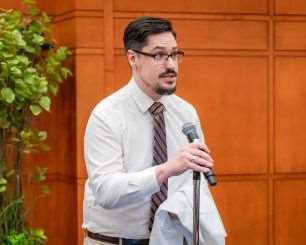 While in school, Noonen continues to work for the VA hospital, as well as fulfilling his most important role: fathering his one-year-old son.
“Becoming a parent means your world shifts,” says Noonen. “What little free time I do have, I love spending with him and my family.”
Noonen juggles these multiple roles through family and colleague support, open communication with his wife, and a watertight Outlook calendar. He also credits MCW’s welcoming culture.
“Every professor has asked, ‘How’s your child? If there’s anything you need or something comes up, let us know and we’ll do whatever we can to help,’” says Noonen. “Just knowing that they are understanding, supportive, and that there are resources and opportunities to accommodate has been a huge help.”
After graduation, Noonen hopes to complete a cardiology pharmacy residency and return to the VA to practice critical care and cardiothoracic pharmacy.
For prospective students considering a similar path – particularly those with backgrounds like his – Noonen offers his perspective.
“If you are looking to start pharmacy school but are non-traditional or have a family, don’t be afraid to make it happen,” he says. “It’s doable. You don’t have to sacrifice your family for your passion or vice versa.”
MCW School of Pharmacy Admissions FAQ
The MCW School of Pharmacy is the only pharmacy school in the Midwest to offer an accelerated 3-year Doctor of Pharmacy degree at a premier academic medical center. Interested in advancing your career with MCW?
Recommended


