Showcasing Scientific Breakthroughs at Research Day 2026
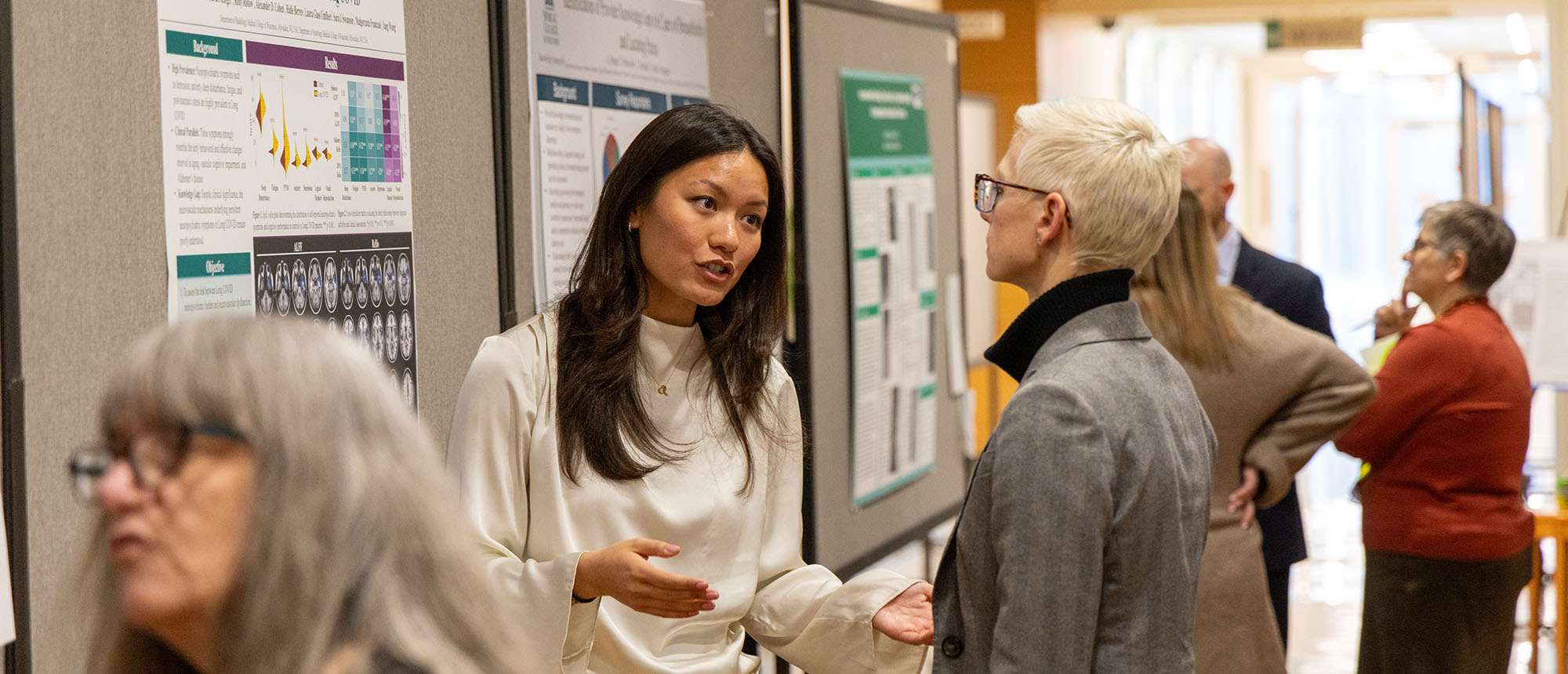
At the 16th annual Medical College of Wisconsin (MCW) Research Day, held on Thursday, March 12, researchers exploring pre-surgery anesthesiology consultations, in-patient social needs screening, and the eyes of Zebrafish were all together in a single room. Organized by the Office of Research, the event brought together more than 160 learners, faculty, and staff to showcase their scientific discoveries via poster presentations.
“Today we celebrate the innovative science happening every day at MCW. We’re proud to showcase the accomplishments and aspirations of our researchers, and we hope you take this opportunity to learn from one another, spark new ideas, and explore potential collaborations,” says Ann Nattinger, MD, MPH, MACP, vice dean for research, who opened the day with brief remarks.
Next, the 2026 Research Staff Awards were presented. These awards highlight employees who have demonstrated significant dedication and commitment to advancing research at MCW.
“Receiving this institutional recognition is an honor, but it’s only possible due to the researchers we work with that energize us,” says Christine Duris, a program manager in the Department of Pathology and Laboratory Medicine, winner of the Core Contributor award.
Research Day also showcased various research support services across campus, such as the Office of Clinical Research and Care Compliance, and how researchers can capitalize on these services.
Nita Salzman, MD, PhD, professor in the Department of Pediatrics and the Department of Microbiology & Immunology, presented the day’s keynote address. Dr. Salzman spoke about her decades-long research on innate immunity and the gut microbiota.
“One thing I’ve learned is that seemingly obscure topics of research can become unpredictably important,” she says. “And that the most interesting science is born of collaboration.”
MCW’s Research Up Close
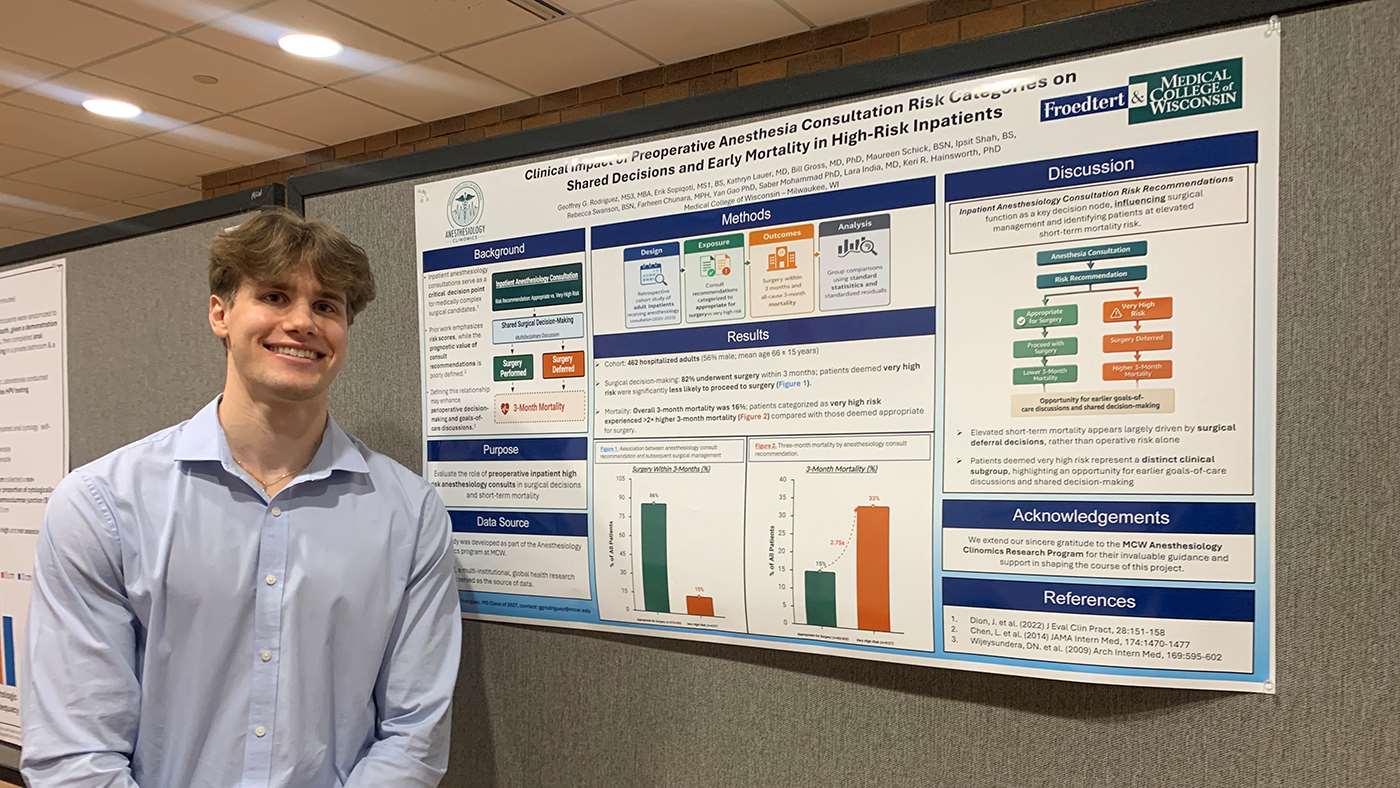
First-year medical student Erik Sopiqoti says Research Day provides attendees the opportunity to explore cutting-edge projects that may have an impact on future therapies and treatment plans.
Throughout the day, there were four different poster sessions, where attendees could learn about the groundbreaking research conducted at MCW.
Kali Palen, a clinical research assistant in the Department of Neurosurgery, presented research on trauma patients’ experiences with social needs screening. This screening identifies patients’ social needs such as housing stability, food insecurity, utilities, transportation, and financial strain risk. Because trauma patients are often in pain, sedated, or emotionally overwhelmed, Palen examined whether these screenings effectively connect patients with support services.
“We discovered that the screenings were generally welcomed by patients and that those completed when the patients were not in these vulnerable states, delivered in a warm conservational tone, and followed up with appropriate resources were the most well received,” she says.
Allison Hall, a PhD student in the Department of Cell Biology, Neurobiology, and Anatomy, shared research on a gene shared by zebrafish and humans that helps the eye process vitamin A–based compounds. When Hall disabled this gene in zebrafish, their eyes could no longer absorb these compounds, altering the structural framework at the back of the eye – a change that can lead to severe eye defects in humans.
“I’m interested in breaking down that mechanism and then seeing if we can translate that back into humans and potentially treat a lot of eye diseases,” says Hall.
Neshatul Haque, PhD, postdoctoral researcher in the Mellowes Center for Genomics Science and Precision Medicine, presented research on how a protein involved in DNA remodeling moves and functions at the molecular level. By remodeling DNA, the protein can turn on and off different genes. When the protein’s movements are disrupted – typically due to underlying genetic changes, the DNA remodeling process can break down, contributing to certain genetic conditions and cancers.
For Erik Sopiqoti, a first-year medical student who presented research on pre-surgery anesthesiology consultations, Research Day was an opportunity to engage with new ideas and take part in scientific discussion.
“Research Day was a way to gain exposure to other students' emerging scientific findings and be able to participate in scholarly discourse,” he says. “As a physician, being able to understand the significance of recent innovations and changes to medical knowledge is important to properly cater treatment plans to the prospective patient population.”
Research Day Winners
Research Staff Awards
- Clinical Research Champion: Elise Rice, clinical research coordinator III in the Department of Emergency Medicine
- Laboratory Leader: Deron Jones, lab supervisor in the Department of Surgery
- Core Contributor: Christine Duris, program manager I in the Department of Pathology and Laboratory Medicine
- Administrative Agent Award: Lynn Cummings, grant operations coordinator senior in the Department of Surgery
Poster Award Winners
- Faculty
- Allyson Hynes, MD, FAAEM, FACEP, assistant professor of surgery and emergency medicine
- David Margolis, MD, PhD, associate professor of orthopaedic surgery
- Fellow
- Alok Arora, MD, fellow in the Division of Nephrology
- Taylor Holmes, PhD, postdoctoral student in the Department of Physiology
- Staff
- Allison Lowman, research associate in the Radiology Quantitative Imaging Lab
- Mikaela Scheer, research technologist in the Division of Neonatology in the Department of Pediatrics
- Student
- Annika Hansen, second-year medical student
- Nicole Hennen, third-year doctoral student in the Interdisciplinary Program in Biomedical Sciences
Recommended


